 Lifecycle marketing
 Customer data management
 Email campaign production
 Search marketing
 CMS development
 Who we are
 How we work
 Case studies
 Testimonials
 Salesforce Marketing Cloud
 Braze
Braze HubSpot
 Marketo
 Pardot
 DataBricks
 Snowflake
 HighTouch
 RudderStack
 Segment by Twilio
 Videos
After sweating blood into optimizing WooCommerce pages, it is truly depressing to see two-thirds of potential customers abandon their online shopping carts.
Around 70% of online shopping carts are abandoned globally, costing businesses significant revenue from customers who’ve already demonstrated clear buying intent.
For retailers, the standard response to WooCommerce abandoned carts is to manually track down these potential customers with generic “You forgot something!” emails after they’ve left the site. But these are increasingly less relevant.
Cart recovery used to operate on the premise that a customer would give you time to be persuasive. That time has gone.
In 2026, customers decide whether to stay in seconds, not through a step-by-step funnel. They encounter a moment, judge it instantly, and either continue the relationship or lose interest and delegate you to background noise at the final step of checkout.
It is a behavioral shift driven by overload and constant choice typical of today’s e-commerce world.
This is where traditional cart abandonment strategies misfire. They rely on batch processing. The usual method to recover carts is to collect abandonment data once daily, segment customers manually, and send generic recovery emails hours or even days after the fact.
The problem is, by then, the moment has already passed. Customer interest has cooled. They’ve likely found alternatives or simply forgotten about their original intent entirely.
This breaks the customer journey at its most critical decision point. Moreover, there is no way to personalize at scale, meaning high-value customers receive the same treatment as bargain hunters
As customer behavior becomes too unpredictable for fixed logic, manual processes are falling short in recovering abandoned carts at scale, which is why successful brands are turning to AI-powered WooCommerce abandoned cart recovery.
Powered by modern AI agents, these WooCommerce abandoned cart recovery tactics respond within the checkout flow instead of after it ends.
Today, let’s talk about how to replace a rule-based, static cart recovery workflow with AI cart recovery in WooCommerce that decides in real-time exactly how to re-engage a customer based on their unique, demonstrated behavior.
Top 8 ways AI reduces WooCommerce cart abandonment
Using AI for WooCommerce cart recovery is not to replace the WooCommerce ecosystem. Neither does it reduce cart abandonment events by punching “smarter reminder emails”.
In reality, AI-powered checkout recovery is to be deployed as an intelligent layer that amplifies core functionalities for providing real-time assistance and removing uncertainty. It reduces abandonment by intervening at the exact points where intent fumbles—and doing so in natural rather than forced ways.
That’s because, at checkout, WooCommerce abandonment generally comes from hesitation. A pause. An unanswered question. A moment of doubt that never gets resolved. In those moments, the anxious shoppers would rather abandon their carts than pause for answers to come from your complex phone interface.
The AI-powered WooCommerce cart recovery system recognizes those moments and addresses the specific concerns blocking progress while the shopper is still mentally present inside the checkout flow. The supported decision-making allows customers to check out with confidence.
Of course, there are outside factors in your customer journey that make them abandon their online purchases. For instance, Baymard’s study found that 43% of online shoppers in the US have abandoned a cart because “I was browsing / not ready to buy”. Don’t worry about them, as there’s plenty that’s within your control.
1) Removing barriers in real time
Most shoppers slow down at checkout when some factor introduces friction or perceived risk at the climax. Even if the buying intent exists, the confidence to move through the payment steps fades, and the shopper drifts away mid-flow.
Here, the practical implication of an AI agent is that it can immediately read this behavioral shift. Long pauses at checkout, stalled payment attempts, or repeated back-and-forth between steps are some of the signals the AI agents identify as blocked progress.
Then, it won’t wait for the session to expire. Instead, it intervenes in real time. Understanding the context, it offers the most appropriate response. That might be clarifying delivery timelines, surfacing fee explanations, or offering assistance.
By engaging shoppers during the decision phase, AI reduces WooCommerce cart abandonment caused by–
- Extra costs too high (shipping, etc.) (39%)
- Separate account creation (19%)
- Too long/complex checkout process (18%)
- Return policy wasn’t satisfactory (15%)
This way, by mirroring in-store assistance that arrives exactly when it’s needed, AI helps the customer decide before uncertainty results in abandonment.
Here’s a must-read for friction-less checkout:
Optimizing the last click: How frictionless checkout drives measurable revenue lift
2) Personalizing the checkout experience without breaking the flow
It is established that inflexible check-out flows are the most prominent factors adding friction at the exact moment a customer is deciding to complete the action. This friction is a precursor to increased cart abandonment, which reduces when a brand removes that friction. AI replaces this friction with personalized experiences.
AI’s advanced segmentation allows you to personalize the experience to the individual shopper in real time based on behaviors, preferences, and purchase history. Plus, tactics like pre-filling known details, using preferred payment methods, and removing unnecessary steps lower cognitive load at the moment of purchase.
Moreover, you can create personalized WooCommerce abandoned cart strategies for specific products, locations, first-time buyers, repeat customers, high/low value carts, etc.
After being rewarded and softened by a personalized check out experience like this, shoppers are a lot less likely to abandon their carts and likelier to respond positively.
3) Conversational support at the point of decision
There are enough questions in the minds of online shoppers as it is. They don’t have the time to hunt down your business policies to get answers. When you give them no fast way to get an answer, there is a risk of shoppers abandoning carts over confusion and lack of confidence.
AI shopping assistants or chatbots live in your WooCommerce store and engage with the shoppers in real time, directly within the checkout experience. They offer:
- Instant, conversational support.
- Explain sizing, returns, warranties, shipping timelines, etc.
- Guidance through the checkout process.
Case in point:
When a shopper moved their cursor toward the exit button, the AI stepped in with a message:
“Heading out? I noticed you were browsing the summer collection. Can I help with sizing details or delivery timelines?”
Taken together, the help appears before shoppers leave, and they stay within the streamlined checkout system on one tabbed page.
4) Intelligent post-abandon follow-ups
Even if the customer doesn’t successfully checkout doesn’t mean it’s a lost sale. This is where an effective AI-powered post-abandonment follow-up lives.
Your AI agents can trigger post-abandon WooCommerce cart recovery automation. It is programmed to evaluate the context and send the follow-up messages accordingly—
- What products are left in the cart?
- What are the shopper’s preferences and purchase history?
- Which checkout step might have caused the friction leading to the abandonment? For instance, a shopper who keeps swapping sizes in their cart is clearly doubting the fit.
Naturally, the follow-ups feel more purposeful and less cookie-cutter in encouraging shoppers to finish checking out. This breaks repeat abandonment loops and avoids conditioning customers to ignore recovery messages altogether.
5) Personalized re-engagement for high-value customers
For retargeting high-intent or high-value cart abandoners, a single reminder doesn’t suffice. Their decision-making process is more complex, and their reasons for abandonment are more varied. Obviously, they need more than basic reminders to return and complete their purchases.
AI-driven workflows in WooCommerce abandoned cart recovery to analyze cart size, product type, and customer history to address specific concerns through a personalized follow-up email sequence rather than a one-off email.
If the hesitation is resolved with the first email, the loop ends with a conversion. If not, the AI adapts and responds as per the shopper’s next move. It could be changing the framing, timing, or emphasis of the next message that doesn’t repeat the same nudge.
6) Dynamic discounts without eroding margins
Discounts can recover lost revenue until they start destroying margins if you start offering a blanket incentive to everyone who abandons a cart.
While discounts are okay to boost short-term conversion rates, they can undermine long-term profitability. And a shortcut to that is a manual, “panic” discounting by setting automated, pre-defined rules within your e-commerce platform.
AI helps you prevent this mistake. It enables dynamic discounting by evaluating cart value, purchase history, and prior responsiveness to offers. Some shoppers convert without incentives. Others need a gentle nudge. AI predicts the right type and size of offer and delivers discounts only when they increase the chances of conversion without bleeding profit unnecessarily.
AI systems also capture behavioral signals like cursor movement or idle time and detect true intent to leave. This prevents the system from showing vouchers to customers who were actually planning to finish their purchase anyway.
Confused between Shopify and WooCommerce? Here’s what you must read:
- Which platform scales better for AI-powered e-commerce: Shopify or WooCommerce?
- WordPress, Webflow, or Shopify? How to choose in 2026
7) Product recommendations
Sometimes, WooCommerce cart abandonment is less about price or timing and more about doubt. The shopper isn’t sure they’ve chosen the right product.
AI-driven product recommendations analyze abandoned cart items and suggest alternatives or complementary products that better match the shopper’s behavior. This reaffirms the buying decision rather than forcing it. It’s sort of a reminder that you’ve their best interest in mind. Once this is done, the shopper is engaged, and uncertainty is resolved that would otherwise lead to exit.
8) Behavioral timing for better cart recovery rates
When you reach out to the cart abandoners, the value is timing as much as the message.
The AI-driven WooCommerce cart recovery system predictively understands shoppers’ browsing patterns and engagement signals. This is super useful for them to determine the optimal time to send cart recovery emails.
That’s when shoppers are most primed to read and engage with your emails. When they’re most likely to be seen, they’re more likely to spur action.
Also, the fact that the interventions are proactive and not premature or late-stage lifts cart recovery by responding while intent is still warm.
Dig deeper:
How to Reclaim Lost Sales with Abandoned Cart Emails (+Examples)
Best WooCommerce abandoned cart recovery plugins with AI capabilities
Let’s now have a look at AI plugins for smart abandoned cart recovery in WooCommerce.
A. Advanced personalization and multi-channel recovery
Omnisend for WooCommerce
- Automated cart recovery sequences
Triggers abandoned cart emails as soon as customers add items but don’t complete checkout. Emails dynamically include abandoned product images and direct checkout links to reduce friction. - Multi-channel follow-ups (Email + SMS + Push)
If customers ignore email reminders, automated SMS follow-ups can be triggered. Unlimited push notifications (even on the free plan) provide additional nudges without relying solely on inbox visibility. - Browse abandonment workflows
Sends targeted messages when visitors view products but leave without purchasing, capturing intent before it turns into cart abandonment. - Advanced personalization and dynamic content
Add personalized content to campaigns and automations. Also, includes abandoned cart links and shipping confirmations. Use conditional content blocks to display different messaging based on behavior or device. - Customer segmentation based on purchase behavior
Pre-built segments (e.g., window shoppers) help target customers showing buying intent. You can segment contacts by:- Items purchased
- Total spend
- Engagement levels
- Purchase frequency
- Lifecycle-based automation
Supports welcome campaigns, post-purchase follow-ups, review requests, and product recommendations to extend recovery into long-term retention. - Revenue attribution and A/B testing
Tracks which campaigns generate sales and allows A/B testing for subject lines, send times, and content to optimize recovery performance. - Signup forms and list growth tools
Customizable forms and popups help capture contacts early, increasing the pool for WooCommerce cart recovery automation.

B) Conversational recovery (AI chatbots)
WoowBot for WooCommerce
- WooCommerce-native AI Chatbot
WoowBot is a plug-and-play chatbot built for WooCommerce. Meaning, it integrates directly within WordPress and enables conversational shopping experiences without the need for external platforms. - Conversational on-site shopping assistant
This reduces friction during product discovery and checkout by helping shoppers:- Browse products
- Find relevant items
- Get guided assistance during purchase
- AI & NLP capabilities (Pro Version)
WoowBot Pro integrates with OpenAI (ChatGPT) and Google Dialogflow. Because of which conversations it can conduct are more intelligent and optimized for natural language. - On-site retargeting with exit intent detection
The plugin detects exiting visitors and displays targeted offers inside the chatbot window. It offers coupon codes, free resources, and promotional messages to potential abandoners. You can set it up to trigger retargeting based on exit intent, time interval, and scroll behaviour. - Cart recovery reminders
Sends reminders to shoppers who:- Add products to the cart, but don’t complete the checkout.
- Leave from other pages before finalizing the purchase.
- Return to the site later with items still in the cart.
WoowBot displays custom reminder messages encouraging order completion.
- Promotional nudges and special offers
Chatbots can offer special promotions or discounts to recover abandoned carts and re-engage hesitant shoppers. - In-chat support and FAQ integration
Provides direct support from the chat window:
- Displays predefined FAQs.
- Allows users to email the site admin.
- Collects feedback if questions remain unanswered.
- Email collection and conversation forms
Enables email capture and interactive conversation forms directly inside the chatbot interface to grow subscriber lists. - Conversion tracking and statistics
Tracks shopper behavior and abandoned cart patterns to monitor recovery performance and optimize offers.

Dig deeper: The Ultimate Categorized WooCommerce Plugin Guide: Must-Haves And Plugins To Skip
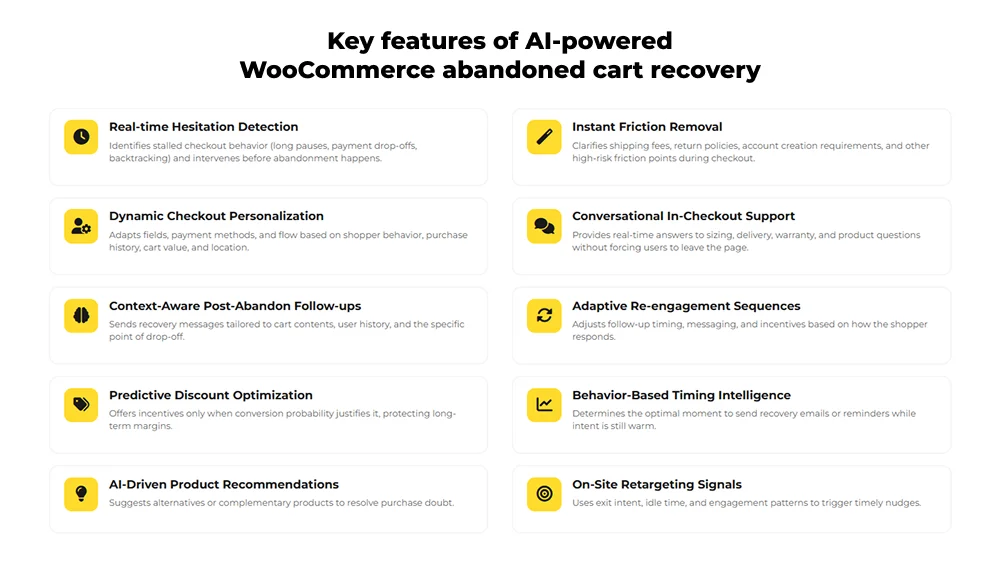
Key features of AI-powered WooCommerce abandoned cart recovery
The road ahead
In 2026, most shoppers don’t abandon WooCommerce carts because they’re just browsing. They abandon because uncertainty goes unresolved in the moment it appears. If your WooCommerce cart recovery system waits, batches, or sends generic reminders, you’re chasing intent after it has already lost its pulse.
Brands that capture the most of the lost sales will abandon static cart recovery tactics for AI-powered WooCommerce cart recovery.
AI-powered checkout recovery doesn’t trust fixed rules or delayed persuasion. It detects hesitation while it’s forming. It removes friction before doubt solidifies. And decides, in real time, whether to clarify, reassure, incentivize, or simply let go. Every intervention matches the demonstrated behavior and not assumptions.
The economics are clear: abandoned carts represent customers who were already halfway to conversion. But recovering them at scale requires systems that move at the speed of decision-making, not at the speed of campaigns.
Static cart recovery workflows cannot keep up with dynamic intent.
The brands that win won’t be the ones sending more reminders. They’ll be the ones resolving uncertainty faster than it forms. And doing so without eroding margins or over-conditioning customers with blanket discounts.
WooCommerce doesn’t need more automation. It needs intelligence layered on top of it.
Adapt your cart recovery to real-time behavior or continue paying to reacquire attention you already earned once and failed to convert.
If this sounds like something you want to try but don’t have expertise for, give Mavlers a shot. We have everything you need to build high-performing workflows that respond to real-time customer behavior across channels and get started with recovering your carts.
Get started with our AI-led Marketing automation services today and see how you can reduce abandons with almost no effort!
More resources:
How Much Does WooCommerce Website Development Cost at Mavlers?