
 Lifecycle marketing
 Customer data management
 Email campaign production
 Search marketing
 CMS development
 Who we are
 How we work
 Case studies
 Testimonials
 Salesforce Marketing Cloud
 Braze
Braze HubSpot
 Marketo
 Pardot
 DataBricks
 Snowflake
 HighTouch
 RudderStack
 Segment by Twilio
 Videos

Yes—Google uses return rates and customer sentiment to evaluate and rank e-commerce stores, especially where free listings search results appear.
In 2026, Google’s ranking systems see the bigger picture beyond on-page e-commerce SEO and content quality.
Post-purchase experience signals feed into how trustworthy your store appears. What’s your product return rate look like? How customers describe their experience in reviews? What kind of return experience customers have with your brand? How explicit are your shipping and return policies to them? All these are not just conversion drivers. They are also a strong signal to search engines that your e-Commerce website has authority and is trustworthy.
Google has precised this while introducing more ways to share merchants’ shipping and returns policies with Google—
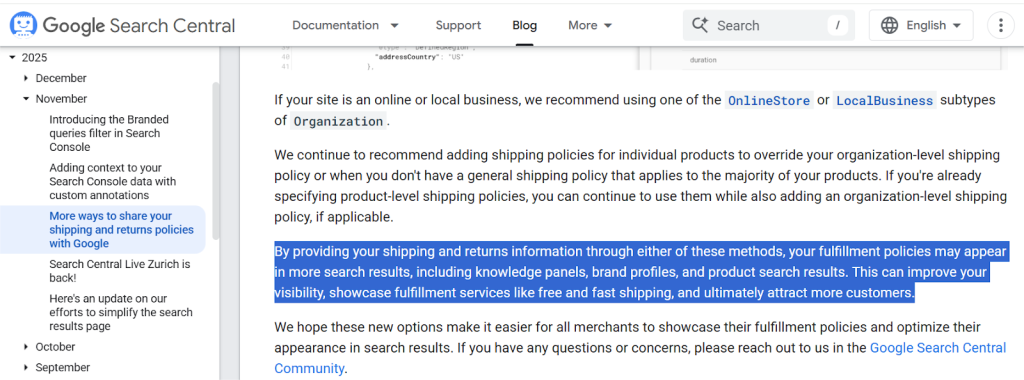
In short, how customers experience your store post-purchase influences the chances of your products appearing in Google’s ecommerce results.
Let’s unpack the different ways post-purchase experiences your store serves to your customers become a core Google trust signal for ecommerce.
Where Store Quality affects your product visibility in Google
We constantly mention to our client brands that an aspect of organic search in general is achieving and maintaining e-commerce trust signals in the eyes of Google.
For e-commerce stores, organic free listing as a surface is expanding rapidly and is only becoming more important with the introduction of various AI-related experiences.
But, one misconception prevails and shows up again and again when you work closely with e-commerce teams: most teams still assume customers enter through the homepage or a category page.
While the reality is, a lion’s share of high-intent traffic lands straight on product pages. Often from Google search results that shoppers trust to compare prices, delivery options, and customer reviews. That’s why product-level search visibility in Google gains so much traction now.
This is where search engine optimization for free product listings comes in.
What’s a free product listing on Google?
Free product listing is a no-cost method to surface your products (eligible!) across many high-visibility surfaces in Google’s organic search estate. With a free listing, you can show detailed product information to shoppers without paid ads. These listings are designed specifically to surface product pages, not homepages, category pages, or policy pages.
These organic product listings work two ways:
- Help Google present consistent, reliable product information.
- Allows shoppers evaluate products on the basis of price, availability, ratings, and shipping details.
To improve its search experience, Google increasingly bypasses traditional blue links. It now offers free product recommendations in various locations on e-commerce SERPs through free product listings.
Rather, it’s a standard way for a product grid to appear directly in the SERP and ahead of all organic results. The trend attests Google’s commitment to a more visual, frictionless shopping experience.
So, if your products are eligible, they might represent your store in shopping-related results across Google in surfaces like:
- Google Search (rich product results)
- The Shopping tab
- Popular Products carousels
- Shopping Knowledge Panels
- Google Images and Google Lens
- YouTube and AI-powered shopping experiences
Dig deeper:
- Visual search moats: How to rank for Google Lens queries (When the camera becomes the storefront)
- How To Optimize Product Feeds And PLAs To Get Discovered In AI Search
To enable these free product listings, Google requires Google Merchant Center. The product attributes in Google Merchant Center is Google’s foundation for showing products for free. This means the structured product data such as pricing, availability, shipping details, and return policies.
As an e-commerce brand, it’s imperative that you keep this data accurate and fresh. Doing this helps Google display your products consistently across search and shopping experiences.
In the Merchant Center, this shows up through the Shopping Experience Scorecard, where domains are rated on a spectrum, from low to exceptional. Shipping speed, clarity of return policies, product accuracy, and customer feedback all contribute to it. Stores with stronger ratings are considered more reliable shopping destinations.
A higher store quality rating doesn’t mean your homepage tops the standard search results overnight. But it does improve eligibility and visibility within Google’s shopping ecosystem, free product listings and Shopping ads, in particular.
Products from higher-quality stores are more likely to surface in top-tier shopping placements and garner stronger click-through rates, because Google has more confidence sending shoppers there.
More on: How to earn Google’s Top Quality Store badge in e-commerce: A practitioner’s playbook
How Google uses shipping, returns, and reviews to evaluate your store
Who knew that Google’s measurement of “Merchant Quality” would make your warehouse, customer service desk, and returns department officially relevant to e-commerce trust signals?
Now that it does, online retailers have a lot of catching up to do across the three pillars of the Merchant Quality Score: shipping, returns, and reviews
1. The shipping experience
Shipping policies have long been one of the trust signals on sites that brands have used to make customers feel reassured about their shopping experience. But now it has become one of the clearest quality separators in Google Shopping.
In a large-scale analysis of Google Shopping results (5,000 keywords), stores with “Great” or “Exceptional” shipping scores were significantly more likely to appear in top positions. Not because they promised the fastest delivery. But because they consistently kept their promises around delivery time and cost.
From what we see inside Merchant Center accounts, aggressive promises don’t excite Google. Google rewards predictability. Stores that under-promise and deliver reliably tend to maintain stronger shipping experience scores over time.
Operationally, Google evaluates shipping through:
- Delivery time accuracy.
- Shipping cost competitiveness.
- Consistency across products.
The resulting shipping and delivery experiences reflect in your Store Quality / Shopping Experience Scorecard. Late deliveries and unclear shipping costs can drag a store from “Great” to “Good.” And that downgrade has visibility consequences in Google search. Interestingly, the data shows that lower-priced products and specifically those with lower shipping costs, rank higher.
2. The return experience
Most retailers view the “Returns & Refunds” page as a legal necessity. In reality, it would be a grave mistake to overlook your return policy’s SEO connection. Google now uses your return policy to measure “Website Stickiness” and brand trust.
Google assesses an online brand’s return policy across multiple layers and scores return experience inside Merchant Center, explicitly:
- Policy clarity. Like return window (e.g., minimum 30 days), costs or fees, and step-by-step process (e.g., how to initiate returns).
- Operational follow-through. Such as refund processing within stipulated business days and consistent follow-ups across orders.
- Transparency and compliance. Meaning, alignment between stated policy and actual behavior, flagging discrepancies like unadvertised fees or unmet refund timelines.
We’ve also seen stores suspended entirely due to non-compliant return policies. Google can (and will) suspend accounts with vague return/exchange policies. To be transparent, your policy must clearly state the return window, customer fees, and refund timelines. At the same time, you must walk the talk and follow the said policy while fulfilling your orders.
For example, if your policy says you process returns in two days, but your Merchant Center data shows you take five, your score will drop.
Here’s more on how to handle Google Merchant Center suspension.
3. The review ecosystem
The old strategy was “get as many five-star reviews as possible.” Most teams still think in averages: more reviews, higher stars, better outcomes.
In 2026, the Google trust signals for e-commerce are all about authenticity, review velocity, and cross-platform presence.
The number one reason for this shift is because of AI. AI now audits the text of your reviews.
A review that says “Good shoes” provides practically zero SEO value. However, a review that says “These running shoes have great arch support for flat feet” helps Google to semantically link your product to specific, long-tail search queries.
Likewise for the star ratings. A 4.2-star rating with detailed, specific feedback looks more credible to machines and users than a 5.0-star rating that sounds “thin” or automated.
Moreover, review velocity—the rate at your brand gets new reviews over time is something you might ignore but Google won’t. In fact, more than review volume, it’s the review velocity that Google looks for as an e-commerce trust signal.
Higher velocity indicates fresh activity and ongoing relevance of your business. This is why businesses having recent reviews are valued more, by Google and by shoppers.
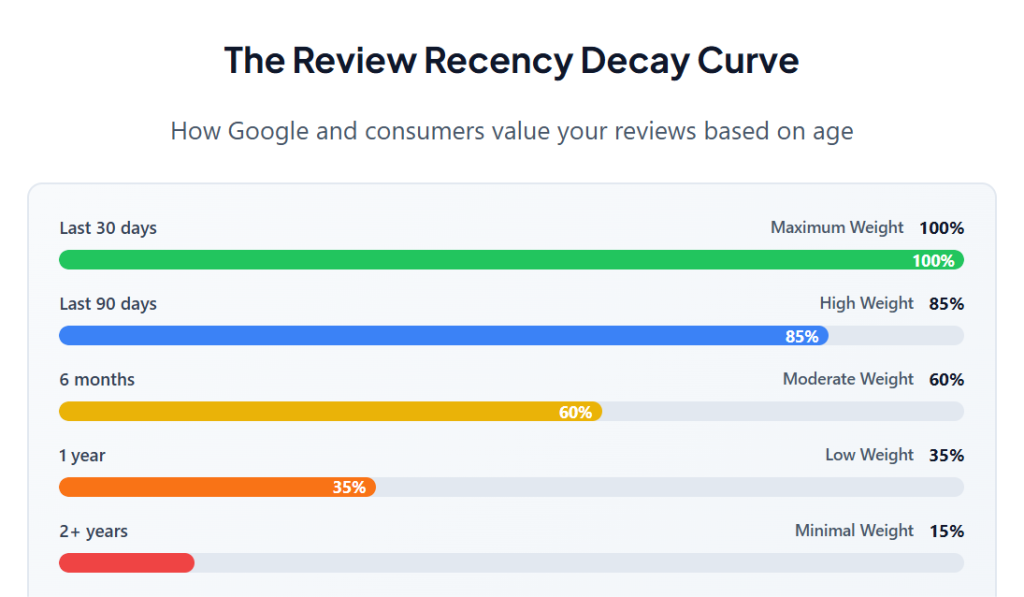
The other factor that accelerates this trend is the fact that how shoppers research trust has changed.
As Shelley Wash, Managing Editor at Search Engine Journal, points out—
Trust in traditional SERP results, especially review-heavy content, has fractured. Younger buyers are skeptical of polished, affiliate-driven “review” pages and manipulated five-star content. That has pushed discovery and validation into other channels.
Reddit, Quora, TikTok, and YouTube now play a direct role in search and purchase decisions. Google has responded by surfacing more of this content directly in its results.
This context rehashes reviews’ function Google store ranking factors–
- When Google evaluates reviews, it’s not just counting stars. It’s calibrating believability across multiple sources.
- Detailed, experience-based reviews are trusted more than generic praise.
- Reviews that talk about fit issues, durability over time, delivery experience, or the returns process are better for creating semantic clarity. They sound like real people because they are.
- Overly positive, vague reviews, sudden review bursts raise doubts. They may still help conversions at the margin. But fail to build long-term trust with either shoppers or Google’s systems.
There’s also a timing element most teams overlook. Reviews collected after fulfillment—once the product has been used and the delivery experience has played out—tend to be more descriptive and more credible. Those are the reviews that reinforce store ratings and support stronger prominence signals, particularly in local and hybrid search results.
FAQs
Is Merchant Quality Score a real Google ranking factor or just for Shopping ads?
The Merchant Quality Score (a.k.a. the Store Quality program) is a real and official Google evaluation system. But its impact is specific. It primarily influences organic Shopping results (free product listings) and visibility and Ad Rank within paid Shopping ads, not traditional blue-link rankings.
Google uses this score to assess merchants’ reliability based on the overall shopping experience. In doing so, shipping speed, return policies, product data accuracy, and customer reviews are the key signals to Google. A stronger score improves eligibility and prominence in Google’s shopping surfaces.
Can fake-looking reviews reduce e-commerce visibility in Google?
Yes. Reviews that appear fake, manipulated, or misleading can reduce e-commerce visibility in Google.
Google now leverages AI, machine learning, and natural language processing (NLP) to evaluate review authenticity. This doesn’t mean every low-quality review triggers a penalty. Still, patterns of inauthentic or manipulative reviews can restrict your search visibility, obscure trust signals, or—in more serious cases—account or profile suspension.
Beyond policy enforcement, fake-looking reviews also fail to build trust with shoppers,. This indirectly hampers your search performance across Shopping, local results, and other discovery surfaces.
Dig deeper:
- AI in local SEO: Your new secret weapon or just another shiny tool?
- 7 Must-Do Local SEO Steps to Rank Higher on Google Maps
- Local Niche GEO For Small Agencies: How To Get AI To Recommend Your Business Locally
How do I know if our Merchant Quality Score is low, average, or high?
You can check your Merchant Quality Score by reviewing the Store Quality section inside your Google Merchant Center account.
The Store Quality dashboard breaks down how your store performs compared to others in your category. The ratings usually are low, fair, good, great, or exceptional. It also highlights specific areas– shipping experience, returns, and customer feedback. So you can have the most actionable diagnostics for remedial steps.
Do Google’s review systems evaluate reviews on my own product pages?
Not directly, but they still matter.
In 2022, Google launched an updated reviews system designed to better reward high-quality product reviews. This system primarily evaluates review content created for ranking purposes, such as editorial or affiliate-style product reviews—not the customer reviews left directly on your product pages.
However, there’s an important nuance. If you publish your own product reviews or work with partners—such as influencers or publishers—who review your products, the quality of those reviews affects how well that content ranks. Poor-quality or thin reviews may struggle to surface, which can limit discovery and ultimately affect conversions.
In short: Google may not “score” your on-site customer reviews the same way, but review quality across the ecosystem still influences visibility, trust, and demand.