 Lifecycle marketing
 Customer data management
 Email campaign production
 Search marketing
 CMS development
 Who we are
 How we work
 Case studies
 Testimonials
 Salesforce Marketing Cloud
 Braze
Braze HubSpot
 Marketo
 Pardot
 DataBricks
 Snowflake
 HighTouch
 RudderStack
 Segment by Twilio
 Videos

The short answer
Braze’s latest product direction moves beyond AI as a writing or productivity assistant toward AI that can participate in how customer engagement is planned, executed, prioritized, and governed. The 2026 announcements introduce capabilities such as Operator Connect, Conversational Agents, Message Prioritization, Agentic Standards, and broader Operator workflows. The practical shift for marketers is not simply “more AI.” It is the ability to connect AI to real customer data, campaign context, operational rules, and execution.
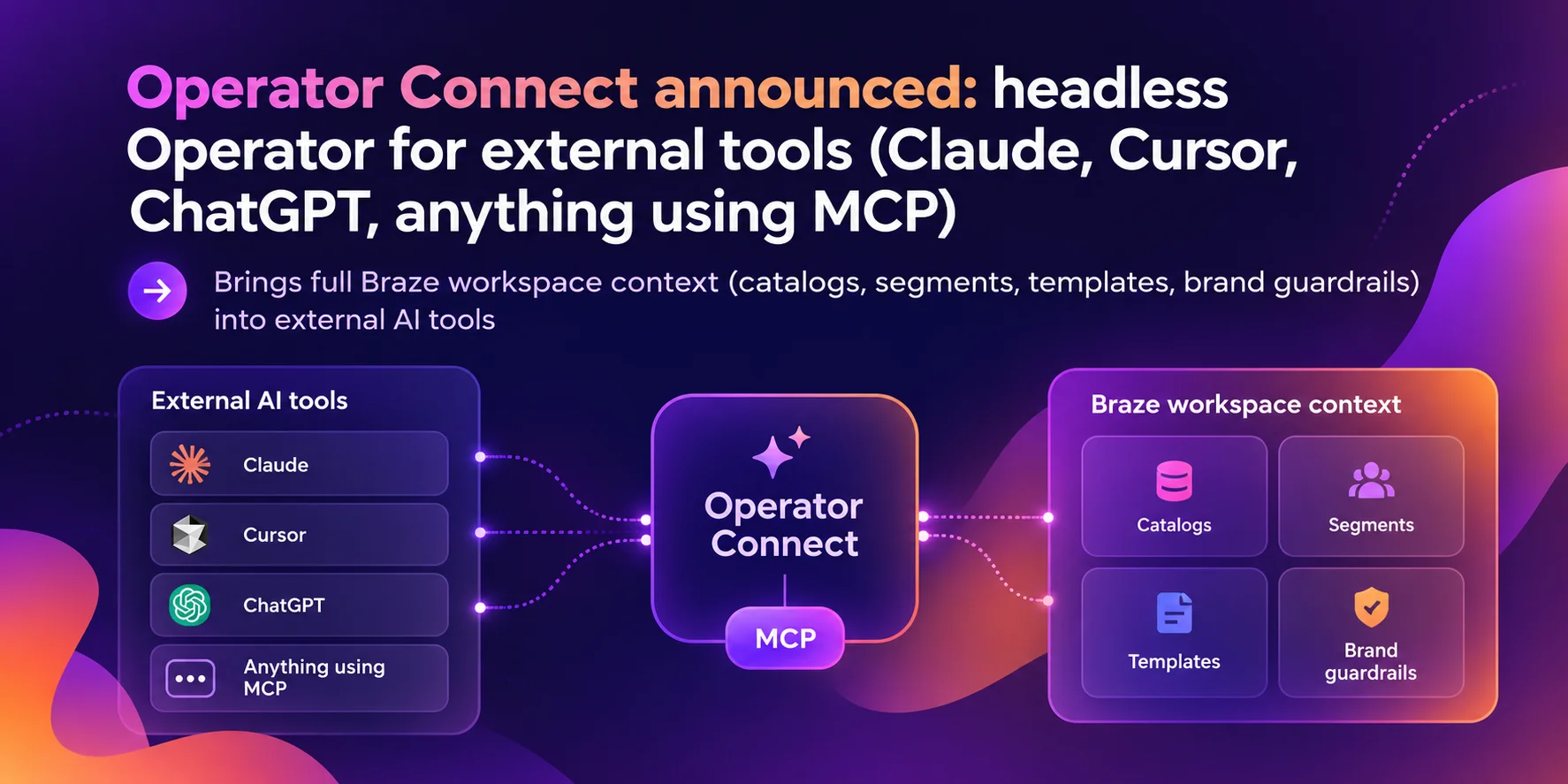
Operator Connect connects external AI tools with Braze workspace context through the Braze MCP Server.
What is changing in Braze’s AI strategy?
The latest Braze announcements describe a platform in which AI can increasingly move from answering questions to helping complete marketing work. Operator can support campaign and Canvas workflows; Decisioning Studio Go brings self-serve AI decisioning to teams; Conversational Agents can conduct on-brand customer conversations; and Operator Connect extends Braze intelligence into tools such as Claude, ChatGPT, and Cursor.
That creates a useful way to think about the change: the marketer still defines the objective, audience, business context, brand requirements, and constraints, while AI increasingly helps perform the operational work around those decisions.
1. Operator Connect: Bringing Braze context into external AI tools
Operator Connect is designed to bring Braze Operator into external AI tools, including Claude, ChatGPT, and Cursor. Braze says the capability is in beta and uses the Braze MCP Server to connect AI tools and agents with Braze through a single connection and standard dashboard authentication.
The important idea is context. Instead of asking a general-purpose AI model to invent an answer about a campaign, the external tool can work with information from the marketer’s Braze workspace. Braze also says actions remain governed by the permissions configured in the Braze dashboard.
For marketing teams, this could reduce the friction between analysis and execution: ask a question in an AI environment, use real Braze context to develop the next step, and then hand execution back to Braze.
2. Conversational Agents: moving from automated replies to task-oriented conversations
Conversational Agents is a beta Braze channel that lets users interact with an AI agent to complete defined tasks. Braze describes workflows in which an agent can use tools to search catalogs, set attributes, log events, or call webhooks.
The difference from a traditional scripted chatbot is the workflow model. Marketers define the purpose, channel settings, target audience, and natural-language steps, while the agent can use approved tools and knowledge sources to complete the task.
Braze’s current documentation lists WhatsApp, SMS, RCS, and web as the conversational surfaces discussed for this capability. The feature remains in beta, so teams should validate availability, supported use cases, and governance requirements with Braze before planning production deployment.
3. Message Prioritization: AI-era orchestration still needs business rules
Customer engagement does not happen one campaign at a time. A customer can qualify for multiple campaigns and Canvas messages that compete for the same frequency-cap space. Message Prioritization gives marketers a way to rank categories and rules so Braze can determine which eligible messages should win that limited space.
This is different from simply limiting message volume. Frequency capping answers how many messages a user can receive; Message Prioritization helps determine which messages should receive that capacity.
Braze’s documentation explains that prioritization evaluates eligible opted-in campaigns and Canvas Message steps that share an applicable frequency-capping rule. Retry windows can allow a message that was not selected to be evaluated again later, subject to the configured rules.
4. Agentic Standards: scaling QA without scaling spreadsheets
Braze has also announced Agentic Standards, planned for availability in October 2026. The concept is to define brand, compliance, disclaimer, tagging, and other campaign QA requirements in Braze so the platform can automatically assess campaigns and Canvases before launch.
The significance is operational: as AI increases the speed at which teams can create campaigns, QA can become a bottleneck unless standards are also made executable. Agentic Standards is positioned as a way to turn parts of a manual pre-launch checklist into repeatable rules.
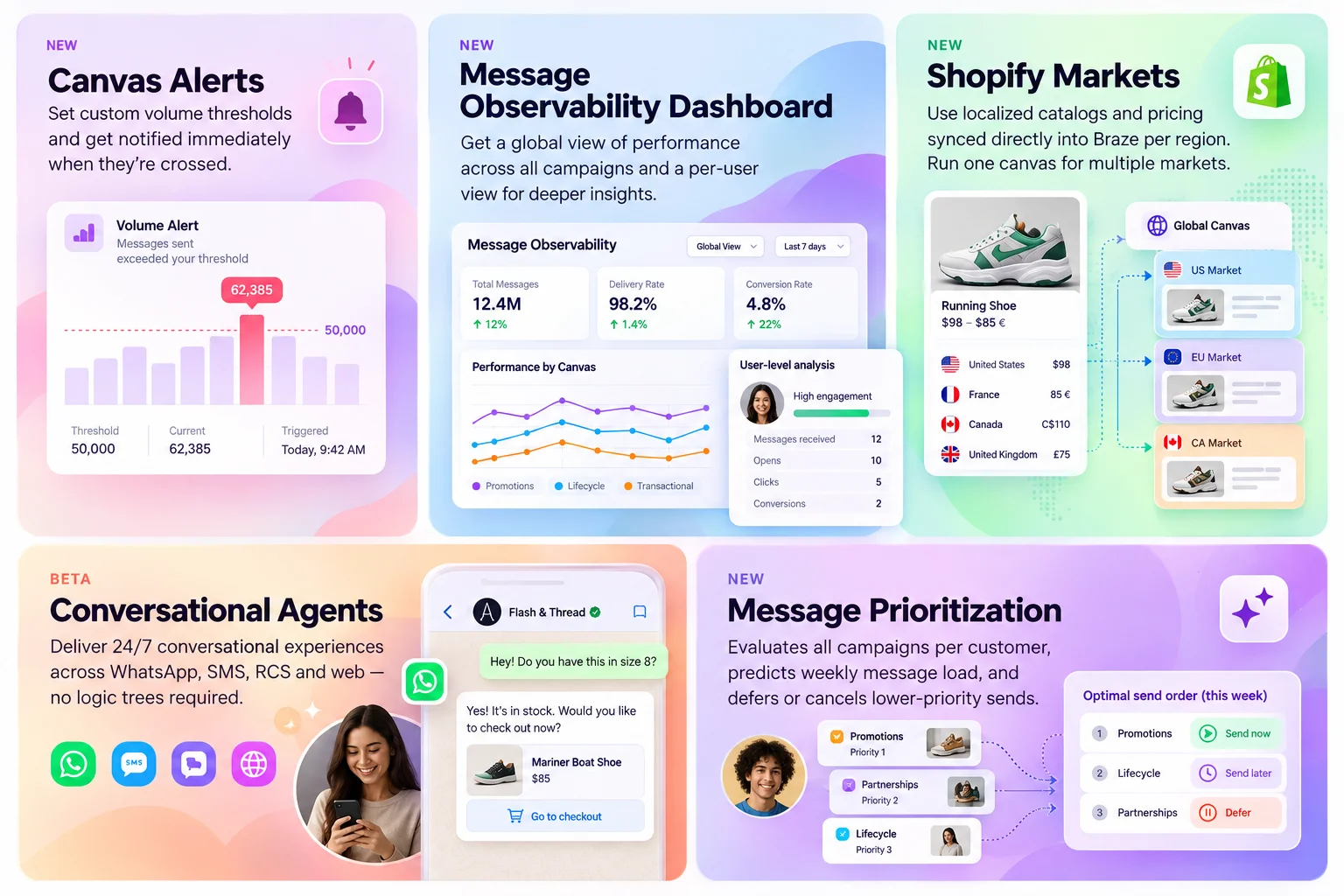
Braze 2026 capabilities span campaign operations, observability, commerce, conversations, prioritization, and governance.
5. Decisioning Studio Go: decisioning becomes more accessible
Braze’s 2026 announcements also position Decisioning Studio Go as a more self-serve path to AI decisioning. Braze describes agents that can select creative and message components and optimize engagement, reducing the need for traditional manual testing and static rules in supported use cases.
This is distinct from generative content creation. Marketers still supply the options and define the business objective and guardrails; the decisioning system determines which available option is most appropriate for an individual within the configured experience.
What does this mean for marketing teams?
- Campaign creation becomes increasingly conversational: teams can describe an outcome rather than manually configure every step.
- Execution becomes more connected: external AI tools can work with Braze context rather than operating as isolated assistants.
- Customer conversations become more dynamic: agents can handle defined tasks across supported messaging surfaces.
- Message orchestration becomes more deliberate: business priorities can determine which eligible messages get the available frequency-cap capacity.
- Governance becomes part of the operating model: standards and permissions matter more as AI gains the ability to perform work.
A practical framework for adopting agentic Braze capabilities
| Layer | Marketing question | Braze capability |
| Create | Can we reduce manual campaign build work? | Operator |
| Connect | Can AI work with real Braze workspace context? | Operator Connect / MCP |
| Decide | Can the platform choose among approved options? | Decisioning Studio |
| Converse | Can customers complete defined tasks conversationally? | Conversational Agents |
| Prioritize | Which message should win when campaigns compete? | Message Prioritization |
| Govern | Can standards be checked consistently before launch? | Agentic Standards |
The bigger picture
The most important change is not that Braze is adding isolated AI features. The platform is increasingly connecting intelligence to the systems marketers already use: customer data, campaign orchestration, message rules, brand requirements, and execution permissions.
For marketing leaders, the opportunity is therefore less about replacing marketers and more about redesigning the operating model around them. The teams that benefit most will still need clear goals, clean data, strong governance, and well-defined rules, but they may spend substantially less time translating those requirements into repetitive platform work.