
 Lifecycle marketing
 Customer data management
 Email campaign production
 Search marketing
 CMS development
 Who we are
 How we work
 Case studies
 Testimonials
 Work samples
 Salesforce Marketing Cloud
 Braze
Braze HubSpot
 Marketo
 Pardot
 DataBricks
 Snowflake
 HighTouch
 RudderStack
 Segment by Twilio

A year ago, when we published a roundup of MAP experts sharing their insights on the agentic paradigm, Marketo stood out for its lack of an agentic agenda. Britney Young, a Market expert and contributor to the piece, highlighted the gap: “The future lies in agentic AI—AI that doesn’t just guide decisions but takes proactive action. In Marketo, this could mean autonomously cleaning and enriching data, normalizing job titles or contact information, or ensuring imports meet governance standards.”
One year later, Adobe has finally caught up. The Adobe Summit 2026 witnessed a rollout of agentic capabilities, such as conversational AI, callable agents, and MCP.
However, transitioning to the agentic ecosystem is fraught with challenges.
As far as Marketo is concerned, agentic success depends on your instance having clean, well-governed data and content to work from. And that’s how Adobe put it too.
So, before you delegate to agents, it’s worth treating your instance to a proper audit.
Marketing automation audit checklist for Marketo Engage
1. Start with the metadata AI reads
Naming conventions function as language. When an agent scans your instance to identify the correct program, it does not interpret intent as a person would. Instead, it relies on structural patterns.
The same principle applies to folder structures. If locating a program requires navigating through multiple levels, an agent accessing the system via API will encounter the same inefficiency. Flatter, more predictable folder structures, and using a single consistent delimiter throughout improve clarity for both humans and machines. Avoid mixing delimiters within your system.
As a practical test, consider whether a new hire or an AI agent using only your documentation could locate the correct program in under 30 seconds. If not, revisit the structure.
API costs are based on tokens. Running a full persona-classification refresh on a database of over a million records typically costs well under $100, much less than commonly assumed. This is important to consider before postponing a cleanup effort for budget reasons. The expense worth considering? The number of man-hours needed to prepare clean training data and develop the workflow!
2. Be honest about data standardization
AI use cases in Marketo, such as persona classification, lead scoring, and next-best-offer logic, require clean input data. For example, a smart list filter that selects any job title containing “CRO” may inadvertently include unrelated titles. While this type of logic may be manageable with manual oversight, it becomes problematic when models draw conclusions from it at scale.
Conducting an audit involves reviewing each field to determine whether or not:
- values are entered as picklists or free text
- a single system of record exists,
- values are normalized at entry or only corrected later
Prioritize foundational fields such as country and region, lifecycle stage, lead source, industry, and role. Addressing these areas first will significantly reduce downstream data issues.
3. Take stock of your custom objects and deletion logic
Custom objects and custom activities are among Marketo’s key strengths. However, they can also lead to unmanageable instances. Only retain data needed for ongoing segmentation. Temporary configurations, such as a one-time entry on a landing page, don’t require permanent storage. Save records only if you will use them repeatedly, such as tracking which product a customer purchased.
Check for orphaned records. These are custom object entries that remain after a person record is deleted. These continue to count against your limits and can compromise any future analysis.
4. Check deduplication maturity
Duplicates undermine scoring and personalization models. Depending on your data volume, solutions may range from manual merges in Marketo to bulk exports, iPaaS-driven automation, or managed deduplication services. For audit purposes, the key issue is not your solution tier but whether duplicates are a recurring problem or a controlled process. If you require mass cleanups each quarter, this indicates that the intake process, not just the database, needs improvement.
5. Write down the unspoken rules
Long-standing systems often rely on undocumented conventions, such as commonly cloned programs, fields that are deprecated but retained, or lists that should not be modified. These unwritten rules are not apparent to new employees or to AI systems unless they are formally documented.
A data dictionary is absolutely key, providing not only a list of field names but details on their contents, ownership, and business relevance. Consistently documenting legacy elements reduces confusion for new team members and anyone referencing your documentation. Additionally, phrasing instructions positively, such as “use the approved template” instead of “don’t use the old templates,” improves clarity for both people and language models. LLMs often struggle with negative instructions.
6. Review campaign structures for automation
To enable Marketo AI agents to act independently, they need clear guardrails that do not require constant approval. Executable and request campaigns address this need effectively. An executable campaign manages a known, repeatable process, such as routing a demo request, providing agents with safe, pre-approved actions instead of requiring them to create new campaigns each time. A request campaign adds a decision-making layer.
These approaches allow agents to operate within defined parameters.
Additionally, a documented center-of-excellence structure, using standard program templates for all campaigns, reinforces this approach. It ensures consistency among teams and provides AI tools with predictable patterns to recognize and replicate.
7. Confirm your lifecycle and channel setup reflects reality
Lifecycle stages and channel tracking inform both AI systems and humans about a prospect’s position in the funnel and their engagement level. If your lifecycle model is outdated or channel statuses do not accurately reflect outcomes, AI recommendations will be based on inaccurate data. Now is an ideal time to ensure your stages align with current sales processes.

Set realistic expectations post-audit
Even with clean data, it is important to set realistic expectations about where AI is effective and where it is not. The concept of a “jagged frontier” is helpful: tasks that seem equally difficult to people can vary greatly in complexity for a model. For example, requesting one example versus a hundred may feel similar to us, but can yield very different results from a model.
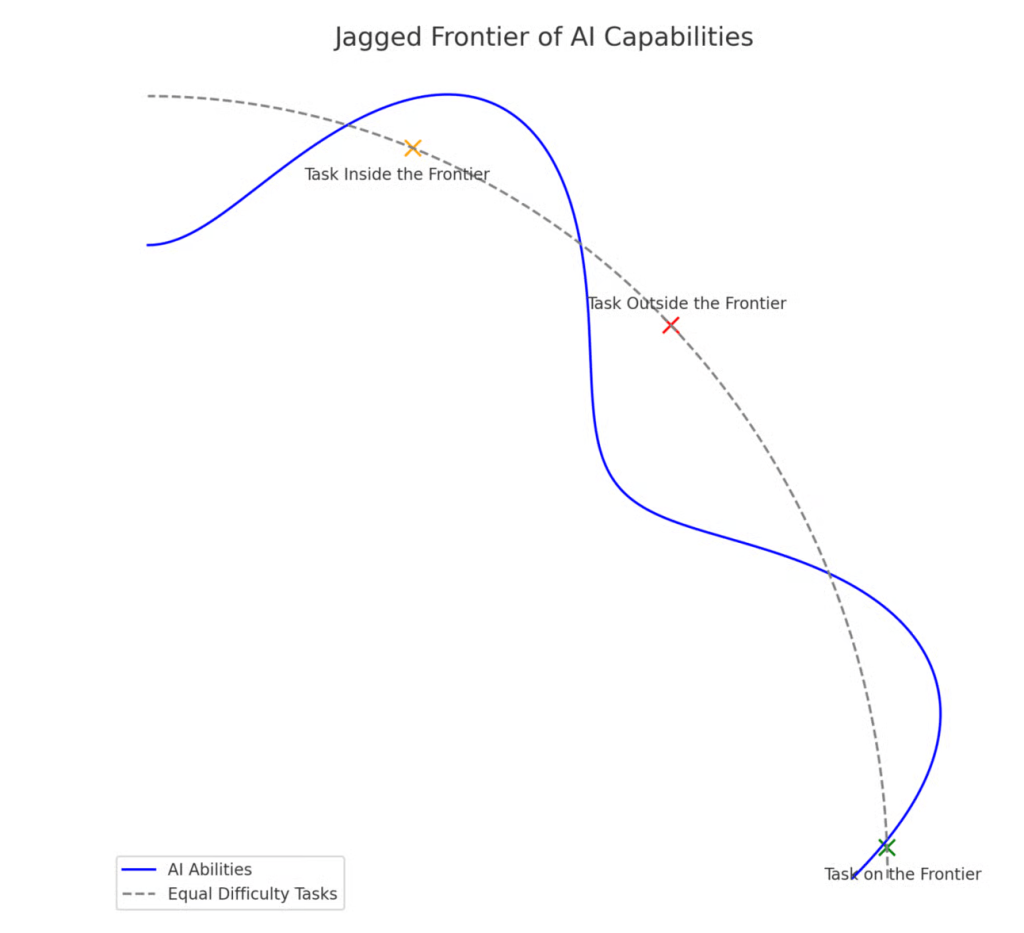
Source: HBS
Two approaches help manage this challenge.
- The “centaur” approach involves a clear division of labor, assigning specific tasks to humans and others to AI, with a defined boundary.
- The “cyborg” approach involves continuously evaluating, task by task, whether AI adds value and making adjustments as needed.
Both methods are effective, but problems arise when teams assume AI is always reliable based on limited success. This is known as automation bias. To prevent this, it is important to conduct regular spot-checks, such as reviewing unsubscribe trends or sampling classification outputs.
Several patterns often emerge only after automation is implemented and should be noted:
- Segmentation logic that is either too broad or too detailed can be problematic.
- Overfitted scoring models can appear highly accurate on historical data but often perform poorly with new leads if trained on too many behavioral inputs. Focusing the feature set and retraining regularly helps prevent this issue.
- Automation bias can occur when a process is successful most of the time, leading to overconfidence in its reliability. Implement ongoing spot-checks, such as monitoring unsubscribe trends or conducting sample audits. Don’t rely solely on past performance.
Post-audit use cases in Marketo Engage
So much for the how part. Now, where to get started with Marketo agents post-audit?
Here are a few use cases to begin with, along with their dependencies and challenges.
| Use case | Core benefit / capability | What it replaces | Prerequisites / dependencies | Pitfalls & challenges to watch for |
| Persona Classification | • Over 95% classification accuracy.• Handles any language automatically without extra rules. | Brittle, hand-maintained keyword rules that break when job title trends change. | • Clean training data.• ~100+ labeled examples per persona.• Balanced persona buckets (not too broad, not too granular). | Low risk overall (uses no PII), but training data must be prepared very carefully. |
| Lead Scoring | Automatically adapts to behavioral shifts and drift over time. | Static, hand-weighted point systems that decay and lose relevance. | • Historical conversion data.• Regular, automated retraining cadences. | • Overfitting the model to too many behavioral features.• Moving too fast without a side-by-side transition period. |
| Next-Best-Offer & Content Recommendation | Dynamically pulls the most relevant asset and drafts personalized outreach. | Manual campaign segmenting and rigid content tracks. | A highly organized, well-tagged content library (by audience, funnel stage, and takeaways). | Much heavier development lift; entirely dependent on the quality of the underlying library. |
Wrapping up
This process does not need to be completed all at once. If your instance has accumulated debt over several years, there is no shortcut. Someone must begin documenting, standardizing, and streamlining. Focus first on the issues causing the most immediate challenges.
It is important to set expectations that results will not be immediate. Implementing any new operational layer, including AI, often leads to a temporary decrease in productivity as people and processes adjust. This is a normal part of adoption and does not indicate that the audit was unsuccessful.