 Lifecycle marketing
 Customer data management
 Email campaign production
 Search marketing
 CMS development
 Who we are
 How we work
 Case studies
 Testimonials
 Salesforce Marketing Cloud
 Braze
Braze HubSpot
 Marketo
 Pardot
 DataBricks
 Snowflake
 HighTouch
 RudderStack
 Segment by Twilio
 Videos
The short answer
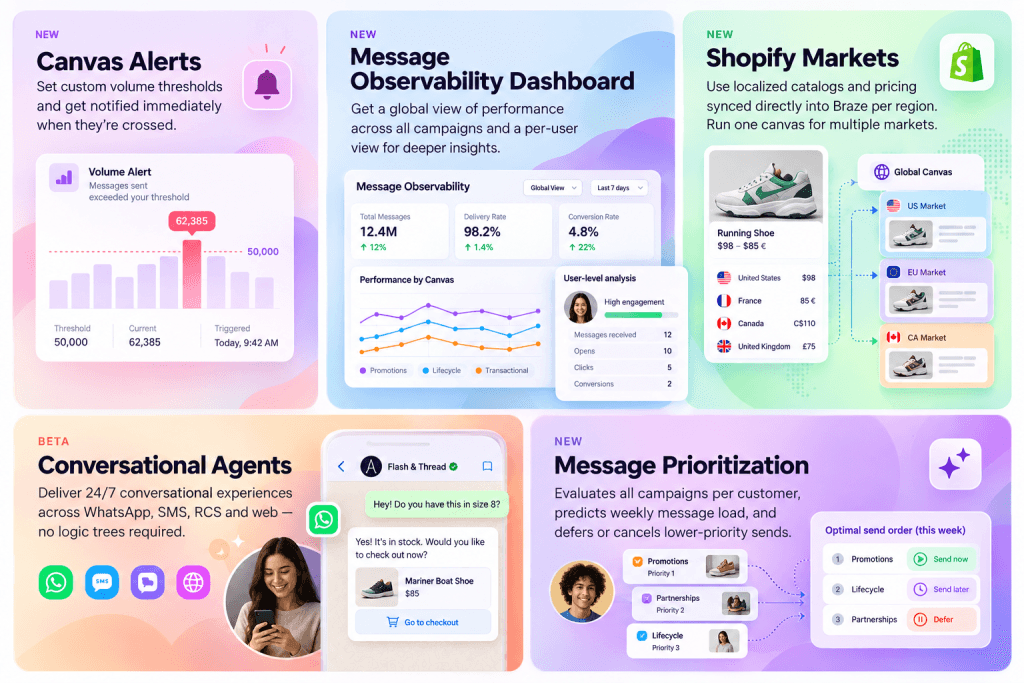
Braze’s latest platform updates are about more than writing better personalized messages. They also cover the operational layer sitting behind customer engagement: spotting problems early, understanding what happened to a send, deciding which messages take priority, and adapting campaigns for more than one market.
Why marketing operations is becoming an AI-era problem
The more campaigns a team runs, the more channels it uses, and the more decisions it automates, the more complicated the messaging environment becomes. And here’s the thing: a campaign can be configured correctly and still not reach customers. Frequency caps, provider failures, audience changes, and other delivery conditions can all get in the way.
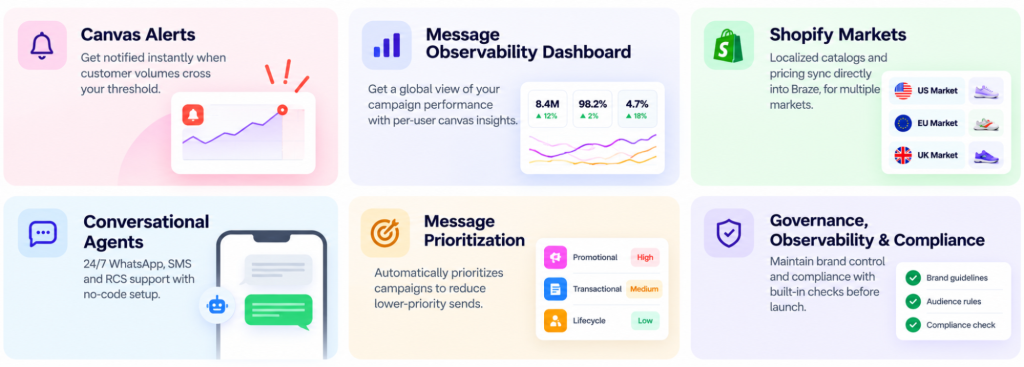
Each of the newest Braze capabilities tackles that complexity from a different side. Alerts tell teams when something needs attention. Observability helps explain what happened. Prioritization settles the competition between messages. And Shopify Markets helps adapt commerce experiences across regions.
1. Canvas Alerts: detect journey problems earlier
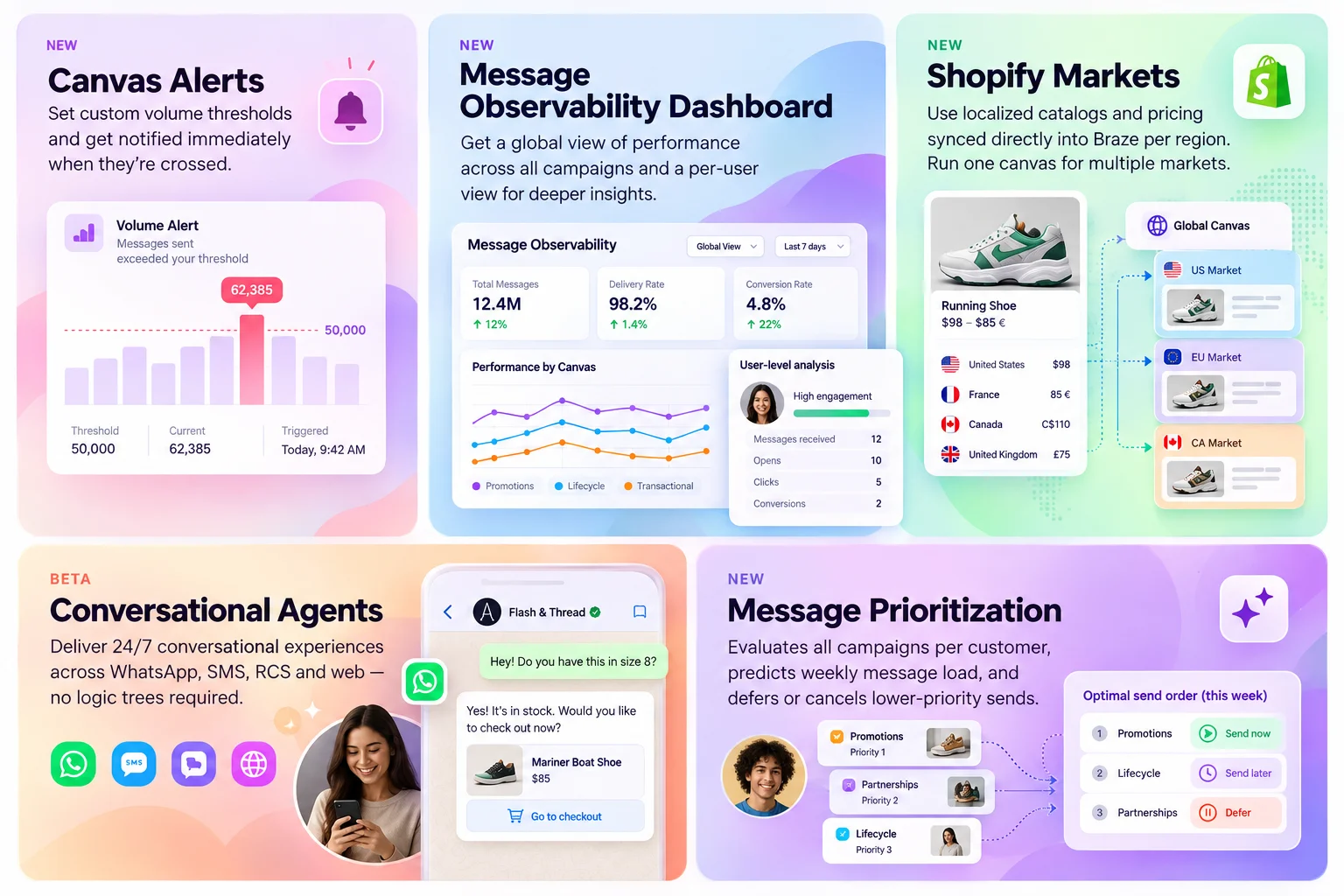
With custom Canvas alerts, teams can set volume or percentage thresholds for user entries or messages sent. When a threshold is crossed, Braze can notify the team by email or webhook.
This matters because journey problems usually surface late, only when a marketer notices that performance has shifted. A threshold gives the team a defined signal to work from. Instead of checking every Canvas again and again, they hear about it when the condition they chose actually occurs.
At the moment, Braze allows up to two alerts on the same Canvas, for example, one for user entries and one for messages sent.
2. Messaging Observability: understand what happened to a message
Messaging Observability gives teams a high-level view of how messages were sent, and helps them look into why campaign or Canvas messages may not have gone out as expected.
Braze’s documentation draws an important line between a message being processed by Braze and that message being finally delivered to the customer. Take email. Braze may hand the message to an email service provider, and the provider decides what happens at final delivery. Push, SMS/MMS/RCS, WhatsApp, and other channels work in a similar way.
That is what makes observability useful when something goes wrong. Not every message that fails to arrive has failed for the same reason, so marketers can look at the exact point where the message stopped moving instead of treating every case as one problem.
3. Message Prioritization: solve the ‘which message wins?’ problem
Frequency capping limits how many messages a customer receives. But on its own, it does not decide which message deserves the limited room that is left.
Message Prioritization adds a ranking layer on top. Marketers create categories and prioritization rules, and then opt eligible campaigns and Canvases in. When several eligible messages compete under the same applicable frequency capping rule, Braze evaluates them and can stop a lower priority message from using up capacity that a higher priority message may need.
A brand might decide, for instance, that a loyalty benefit should come before a promotional partnership message. The platform can then apply that rule the same way every time, so marketers no longer have to sort out each conflict on the campaign calendar by hand.
4. Shopify Markets: one campaign, localized commerce context
Shopify Markets builds on the existing Braze and Shopify integration, so brands can sync selected markets from their Shopify configuration. According to Braze’s documentation, the integration captures Shopify locale information along with the standard country and language attributes, which lets marketers segment and trigger by market.
Braze’s Forge 2026 announcement goes further and describes Shopify Markets as supporting localized language, pricing, currency, and consent, so one Canvas can render appropriately across markets.
The operational benefit here is a real one. Expanding internationally does not automatically mean cloning every campaign for every region. Where the integration and the campaign design support it, the same underlying journey can draw on market-aware customer and commerce data.
5. Governance matters more as automation increases
Visibility and automation need to grow together. Among Braze’s 2026 announcements is Agentic Standards, planned for October 2026, which gives teams a way to define QA requirements for brand guidelines, disclaimers, tagging conventions and other standards.
The wider lesson is that more automation should not mean less control. As platforms get better at doing more work on their own, marketers need clear rules on what can happen, what must be checked, and what still needs a human to review.
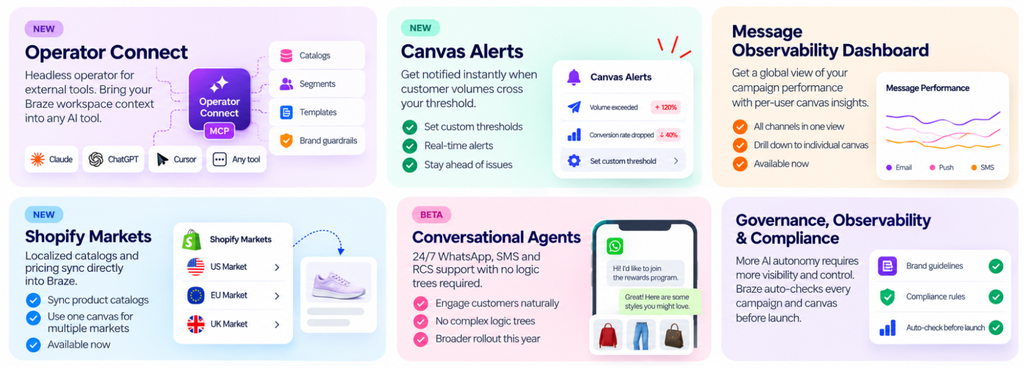
Braze’s broader 2026 operating model ties together observability, commerce, conversational engagement, prioritization and governance.
How these capabilities work together
Take a global retailer running a promotional Canvas:
- Shopify Markets provides market-aware context, so the campaign can reflect regional commerce requirements.
- Message Prioritization helps decide which promotional messages get the limited frequency cap capacity.
- Messaging Observability gives the team visibility into send outcomes and possible delivery issues.
- Canvas Alerts can tell the team when user entries or message volume cross a threshold they have set.
- Governance capabilities can add extra checks as campaign automation gets more sophisticated.
What marketers should change in their operating model
- Move from checking dashboards to monitoring by exception: set thresholds that mean something, and investigate when they are crossed.
- Keep ‘sent’ and ‘delivered’ apart when diagnosing channel performance.
- Treat frequency capping and message prioritization as two different controls, each with its own purpose.
- Build global journeys on reusable logic and market-aware data, instead of duplicating campaigns by default.
- Write down brand, legal, tagging, and channel standards, so they can eventually become checks the platform can run.
- Set up a clear escalation path for the issues that alerts and observability bring to the surface.
A practical readiness checklist
- ☐ Define the Canvas metrics that really signal a journey problem.
- ☐ Set alert thresholds the team can act on, not ones that just create noise.
- ☐ Give the right people access to Messaging Observability.
- ☐ Map out which campaigns and Canvases should compete under Message Prioritization.
- ☐ Agree on clear priority categories and rules before rolling it out broadly.
- ☐ Review Shopify market configuration, locale, language, and currency requirements.
- ☐ Document QA and compliance rules before bringing in more autonomous campaign execution.
The bigger picture
The story of Braze is increasingly about the system around the message, and not only the message itself. Modern customer engagement teams need to know what is being sent, why it is being sent, what competes with it, whether it reached the customer, and whether the campaign followed the rules.
Put together, alerts, observability, prioritization, localized commerce data, and governance give marketers more ways to manage that complexity in a structured way. For teams scaling customer engagement across channels and markets, that operational layer can matter as much as personalization itself.