 Lifecycle marketing
 Customer data management
 Email campaign production
 Search marketing
 CMS development
 Who we are
 How we work
 Case studies
 Testimonials
 Salesforce Marketing Cloud
 Braze
Braze HubSpot
 Marketo
 Pardot
 DataBricks
 Snowflake
 HighTouch
 RudderStack
 Segment by Twilio
 Videos
Email and SMS aren’t auxiliary channels. Brands with mature Klaviyo setups commonly attribute 40-65% of total store revenue to these channels. For higher-ticket categories where the consideration cycle is long and trust is the bottleneck to purchase, that percentage climbs further. A $1,000 product requires repeated, credible touchpoints before most customers will buy. Paid ads create awareness. But email and SMS do the actual selling.
So, what does your current Klaviyo setup look like? Does your Klaviyo attribution sit below 25% of the total store revenue? If so, maybe it’s not set up as it should be.
Let’s find out how you can implement Klaviyo SMS marketing alongside email (and vice-versa) for omnichannel e-commerce marketing.
Email and SMS strategy in Klaviyo for omnichannel e-commerce marketing
Optimize your pop-ups
Brands convert somewhere around 2-4% of website visitors into email subscribers. The goal is to get that number to 10-17%, which is achievable with the right pop-up strategy.
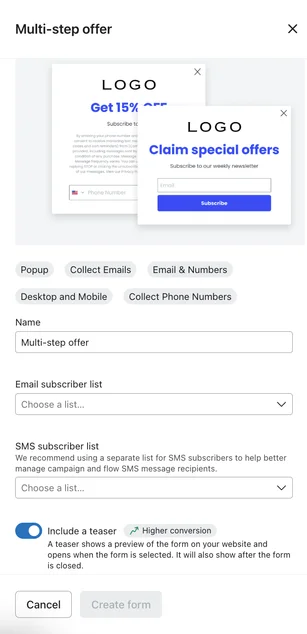
To begin with, consider redesigning your pop-ups into mult-step forms. Here’s why:
- Low barrier to entry: When a site visitor sees a question instead of an email field, the ask feels smaller. They’re just answering something, not handing over personal information.
- Commitment bias: Once someone answers your first question, they’ve started a process. By the time the email field appears, they’re already invested.
- Customization bias: Asking someone what problem they’re trying to solve tells them that you’re going to personalize what comes next. People respond to that.
- Novelty. A well-designed multi-step form will naturally stand out because it’s different.
Klaviyo’s form builder supports a multi-step form natively.
Beyond the format, test your offer aggressively. Klaviyo’s built-in A/B testing for forms lets you pit different incentives against each other, like percentage off, dollar off, free shipping, etc. Run each variant for enough traffic to be statistically meaningful.
| Form A/B testing in Klaviyo | |||
|---|---|---|---|
| Testing area | Priority | What to test | Details |
| Offer type | First | Percentage off vs. dollar amount vs. mystery discount vs. free item with order | Dollar-amount discounts often outperform percentage equivalents on lower-AOV products. Oddly specific discounts like 21% may outperform round numbers like 20%; validate through testing |
| Trigger timing | Second | Page load vs. scroll depth vs. exit intent | Exit intent targets otherwise lost visitors and should always be tested as recoverable traffic. |
| Form structure | Third | Survey-first vs. discount-first vs. single-step | Measure whether question-led forms improve email and SMS opt-in rates against current benchmarks. |
| Incentive stacking for SMS | Fourth | Additional incentive at phone-number step | After optimizing the email form, test added benefits such as extra discounts, exclusive access, or free shipping for SMS opt-ins. |
| Mobile layout | Ongoing | Mobile usability and responsiveness | Since a majority of opens occur on mobile, forms should be validated on phones before launch. |
For SMS collection, don’t ask for email and phone in the same form. The drop-off rate kills your overall conversion. Instead, build a separate Klaviyo form that targets only the people already on your email list — Klaviyo lets you set form audience conditions based on list membership — and offer an incremental incentive in exchange for their cell. Stack a small additional discount or free shipping on top of whatever they already received for the email signup.
Additionally, post-purchase is a second viable SMS collection moment. Customers who have just bought are in a peak-trust state. Asking for a phone number at the order confirmation stage — with a transparent value exchange like shipping updates or exclusive restock alerts — converts at rates that cold traffic cannot match.
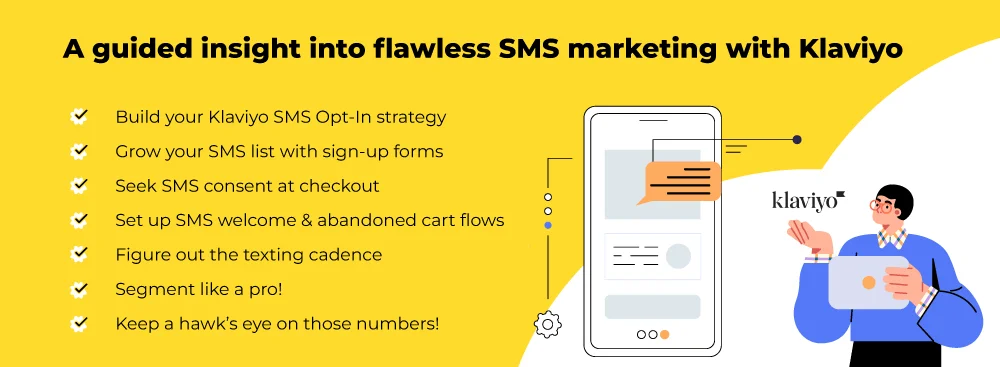
Klaviyo SMS marketing checklist
Design your automated flows
Flows are where Klaviyo shines. When they’re built properly, they generate revenue continuously without you needing to touch them. Here’s how to approach each core flow.
Welcome flow
This triggers when someone subscribes through your signup form and joins your main Klaviyo list. Its job is simple: deliver the discount, introduce the brand, and get that first purchase. Four to five emails is a solid starting structure, separated by roughly one day each.
Consider using Klaviyo’s conditional splits in the welcome flow. You can split the flow based on whether someone has already made a purchase. So if they buy after the first email, they exit the discount-focused sequence and enter a branch more relevant to their lifecycle stage.
Abandonment flows
Klaviyo allows you to design separate flows for site abandonment, browse abandonment, cart abandonment, and checkout abandonment.
Use all four, because they target people at very different points of intent:
- Site abandonment identifies people who visited but never viewed a product. Two to three emails pointing them toward bestsellers and building brand credibility is enough.
- Browse abandoned fires when someone views a product page but doesn’t add to cart. (Klaviyo’s dynamic content blocks can be really useful here. You can pull in the product the person viewed, automatically, without building a separate flow for every SKU.)
- Cart abandoned and checkout abandoned should be separate flows with a filter on the cart abandoned flow. Add a flow filter that excludes anyone who has started checkout since entering the flow. Otherwise you’ll send both sequences simultaneously. Checkout abandoned typically needs more emails than cart abandoned because those people were closer to buying.
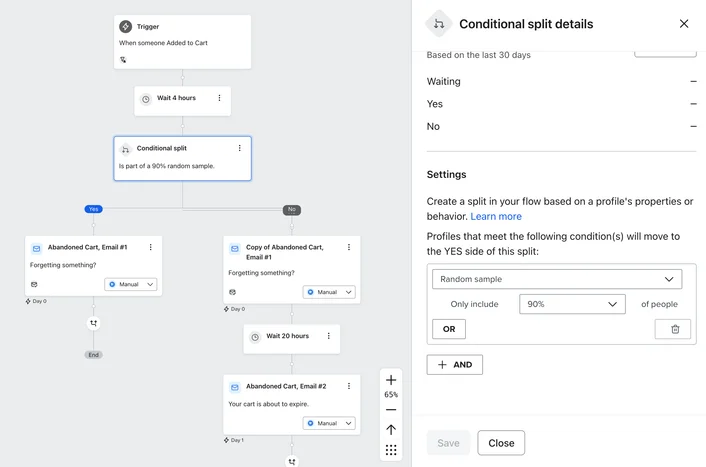
Time delays matter enormously. Luckily, you can A/B test time delays within flows in Klaviyo. A checkout abandonment flow that sends its first message 20 minutes after abandonment can outperform the same flow sending four hours later by several percentage points in placed-order rate. Test timing. Then test it again after, say, three months of list growth, because audience composition changes the optimal answer.
Post-purchase flow
Triggered by the Placed Order metric in Klaviyo. Add a 20-minute delay on the first email so it doesn’t clash with Shopify’s automatic order confirmation. Follow with an upsell recommendation at day two, then a cross-sell around day fourteen. Klaviyo’s product recommendation blocks can automate the product suggestions based on purchase history.
Win-back flow
The win-back flow is for customers who purchased 90 days ago but haven’t bought since.
To start with, send four emails with a clear offer. If you’re sending campaigns three to four times per week through Klaviyo, this flow will naturally generate less revenue because those customers are already re-engaging through campaigns. But if your campaign volume is lower, win-back can do some serious heavy lifting.
Sunset flow
The sunset flow is for email subscribers who have been inactive for 180 days.
The goal is list hygiene. Klaviyo charges based on active profiles, so suppressing chronically unengaged contacts reduces your bill and protects your sender reputation.
Send two emails trying to re-engage, then suppress anyone who doesn’t respond.
So much for email flows. Refer to the below table for the corresponding SMS flows.
| How to build SMS flows alongside email | ||
|---|---|---|
| Flow | SMS strategy | Details/recommendations |
| Welcome series | Build a separate SMS welcome flow triggered by SMS list subscription. Deliver the discount code immediately. | Limit to 1-3 messages maximum. |
| Cart / checkout abandonment | Send one SMS only. | Often managed through a conditional split inside the existing email flow or handled separately. |
| Browse abandonment | Send one SMS featuring dynamically the viewed item. | High-volume flow, so execution should remain frictionless. |
| Post-purchase thank you | Layer one SMS alongside the email. | Keep the tone brief, personal, and similar to a shipping confirmation. |
| Win-back | Send 1-2 SMS messages with a discount code. | Schedule messages outside quiet hours. |
| Fulfilled order / cross-sell | Optional SMS touchpoint. | Some practitioners skip SMS here to preserve channel goodwill for campaigns. |
When you configure your SMS-specific list in Klaviyo, set it to single opt-in.
Double opt-in requires the subscribers to confirm a second time before entering your flows, which creates unnecessary drop-off and delays the welcome message they were just promised.
Compliance note
Behavior-triggered flows — cart abandonment, checkout abandonment, browse abandonment — are legally limited to one SMS per trigger event. If you want to follow up further, use email.
Email campaign frequency and content strategy
A realistic starting point for most brands is three to four email campaigns per week to an engaged segment. The key qualifier is ‘engaged segment;’ you should not be broadcasting to your entire list. Sending to unengaged contacts affects deliverability, and inbox providers will begin routing your emails to spam if open rates drop toward 20-30%. By contrast, sending to a tightly segmented engaged audience and generating 60-70% open rates signals to Google and Yahoo that your emails are wanted, which keeps you in the primary inbox.
But how would you define an engaged segment? If a cohort of subscribers opened at least once and clicked at least once in the past 90-120 days, that’s an engaged segment.
Text-based emails also serve a distinct purpose in the mix. They feel personal in a way that graphic templates cannot replicate, and they often outperform on conversion. But of course, use them once a week as part of a varied rotation, not as a replacement for visual design.
For graphically designed emails, designing in a dedicated tool like Figma before uploading images into Klaviyo produces cleaner layouts and better deliverability than building emails entirely within Klaviyo’s native editor. Emails assembled in Klaviyo’s editor can carry excess HTML and inline styles that trigger spam filters. Designing externally and importing images as clean assets tends to produce leaner code, better rendering across clients, and improved inbox placement.
As far as content is concerned, established brands typically rotate their campaigns around:
- Value and education: Product usage tips, ingredient explainers, industry myth-busting, FAQ responses.
- Brand and community: Founder/CEO emails, customer features, UGC, cultural tie-ins.
- Promotional: Sales, launches, restocks, limited-time offers.
Leading too heavily on discounts erodes brand equity and trains customers to wait for a deal. One promotional send per month, anchored to genuine urgency (a restock, a pre-order window) tends to outperform repetitive discounting.
SMS campaign, frequency, and cost
SMS campaigns operate on stricter rules than email, and getting them wrong is significantly more damaging, because the cost of unsubscribing on SMS is permanent. A person who unsubscribes from your email list can be re-engaged. A person who opts out of SMS cannot receive texts from you again, at least in most regulatory frameworks.
In light of that, it is important to keep a few things in mind:
- Aim for 3-5 SMS campaigns per month. That’s the ceiling for most brands, although the number may go up or down on either side, depending on the context.
- SMS billing is per segment, where a segment is 160 characters for standard SMS. If you go even one character above, you’ll be charged for two segments.
- Emojis can push you over the single-segment limit faster than regular characters because they’re encoded differently. Avoid unless the message stays within the limit.
- MMS costs 3x a plain-text message. Unless you need to use an image, such as for a cart abandoned flow, avoid MMS.
As far as SMS is concerned, keep it text-only, short, direct, and include a clear CTA with a link.
Final thoughts
Three of the four stages in a standard e-commerce funnel — consideration, conversion, loyalty — are driven primarily by email and SMS. Yet most brands allocate the majority of their marketing resources to the top of the funnel, where they have the least control and the highest costs. If you want to see incremental gains, rebuild your brand’s unit economics entirely.
Instead of trying to find more customers, configure Klaviyo to make each customer you already haveworth more money, which makes the entire business more stable and profitable.