 Lifecycle marketing
 Customer data management
 Email campaign production
 Search marketing
 CMS development
 Who we are
 How we work
 Case studies
 Testimonials
 Salesforce Marketing Cloud
 Braze
Braze HubSpot
 Marketo
 Pardot
 DataBricks
 Snowflake
 HighTouch
 RudderStack
 Segment by Twilio
 Videos

So, you are a CRM manager, lifecycle marketer, or email deliverability specialist.
And hardly a few phrases trigger a visceral reaction quite like “IP warming” in Braze.
Isn’t it? It’s just another sign of underutilizing Braze.
It is a familiar scenario for deliverability and CRM teams.
You have spent months planning a migration to a new Email Service Provider (ESP), or perhaps you are launching a dedicated IP address for a new high-volume sub-brand.
- The creative is ready.
- The product team has aggressive growth targets.
- The C-suite is asking about launch dates.
And standing between their ambition and the inbox is the fragile, volatile, and often misunderstood process of warming up a new IP.
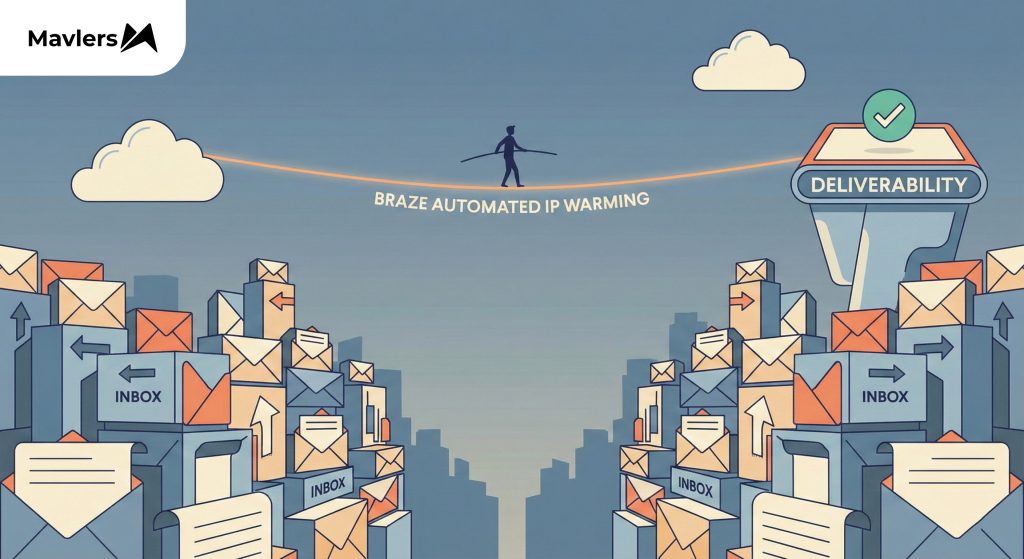
Technically, IP warming is simple: it is the gradual increase of email volume over time to establish a reputation.
Operationally, it is a high-wire act. It carries a disproportionate amount of risk relative to the actual task. One wrong move, one aggressive send to a cold segment, one day of rushing the schedule under executive pressure can tank your sender reputation before you have even truly begun.
However, it doesn’t have to be this way.
The introduction of automated, adaptive IP warming, specifically within platforms like Braze, shifts the paradigm.
By moving from static spreadsheets to dynamic, signal-based volume ramping, we can reduce the risk of human error, alleviate operational stress, and significantly accelerate time-to-value.
This comprehensive article will explore why the old way is broken and how automation offers a simpler path to the inbox.
Let’s cut to the chase.
Why IP warming exists and why it is non-negotiable
To understand why automation is such a breakthrough, we must first respect the mechanics of the inbox. We have to understand the environment we are trying to enter. So, we will try to unravel the crucial questions around IP warming that cloud our minds.
So, what is IP reputation actually?
Inbox Service Providers (ISPs) view every incoming connection with skepticism. Your IP reputation is essentially a credit score for your email program. It is a measure of trustworthiness built on historical behavior. Just as a bank wouldn’t loan a million dollars to someone with no credit history, Gmail won’t deliver a million emails from an IP address it has never seen before.
How inbox providers evaluate sender trust
ISPs are protective of their users. Their primary goal is to filter out spam and malicious content. To do this, they evaluate sender trust based on consistency and engagement. They are looking for patterns: Does this IP send predictable volumes? Do recipients open these emails? Do they scroll past them? Or worse, do they mark them as spam?
Why are new IPs treated with suspicion?
When you provision a new dedicated IP address, it is “cold.” It has no history. In the eyes of an ISP, a cold IP is indistinguishable from a spammer who just spun up a server to blast out millions of junk emails. Spammers frequently “snowshoe”, hopping from IP to IP to evade detection.
What happens when IP warming is skipped or rushed?
If you ignore these limits and blast your full audience on Day 1, the consequences are immediate and often severe.
- Throttling and temporary blocks
- Spam folder placement
- Long-term reputation damage and recovery challenges
So, let’s see how the traditional IP warming processor actually works.
10 Traditional IP warming process and why teams dread it
If you have ever managed an IP warm-up manually, you likely have a specific spreadsheet saved on your drive that haunts you.
Here are some of the traditional IP warming processes that don’t cut it anymore.
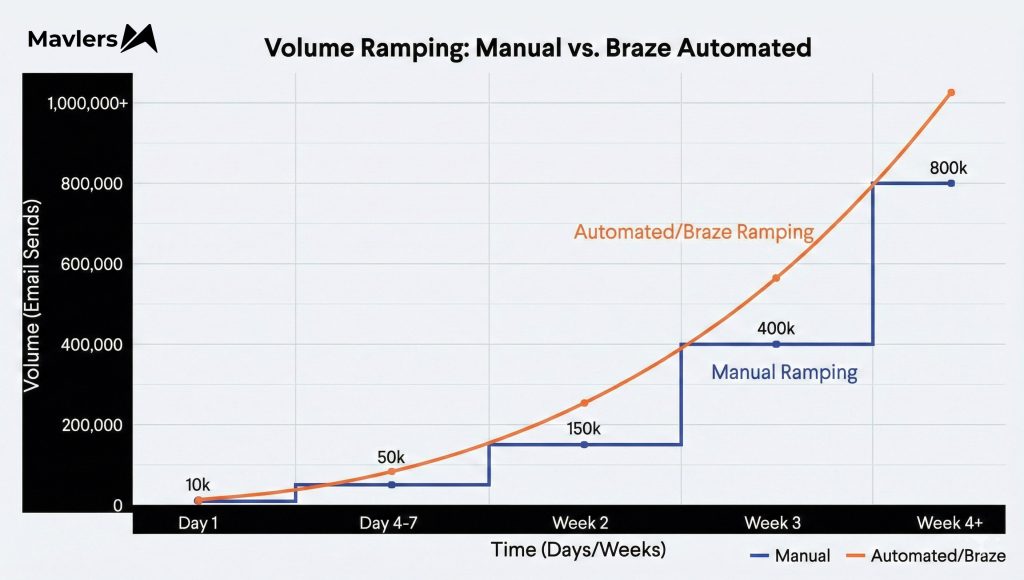
1. Manual volume ramping
The traditional method involves creating a linear schedule.
- Day 1: Send 50 emails.
- Day 2: Send 100.
- Day 3: Send 200.
This manual volume ramping is tedious and prone to mathematical errors.
2. Linear schedules and predefined caps
These schedules are usually based on general “best practices” rather than the specific reality of your audience. They are linear progressions that do not account for the nuances of your specific industry or the ISPs you are targeting.
3. Assumption-driven planning
The plan assumes that if you send 100 emails, they will be good emails. It assumes a standard open rate. It is a plan built on “hope” rather than data.
4. Audience segmentation complexity
The hardest part of manual warming is not the math; it is the audience. You are told to target your “most engaged” users first to build a good reputation. But defining “engaged” is complex.
5. Defining “most engaged” users
Is an engaged user someone who opened an email in the last 30 days? What if you are migrating platforms and don’t have that data? What if your product is seasonal, and nobody has opened an email since last Christmas? If these questions go unanswered, you know it’s time to change the game.
6. Engagement window inconsistencies
Trying to map engagement windows from an old system to a new system is fraught with inconsistency.
7. CRM, lifecycle, and product dependencies
You have lifecycle flows running, welcome emails, abandoned carts, and password resets. You cannot simply turn these off for a month while you warm up.
8. Cross-team misalignment risks
Marketing wants to send a newsletter. The product wants to send an update. Deliverability says “stop.” This creates friction.
9. Manual tracking of sends and signals
Every morning, someone has to log in, check how many emails were sent yesterday, review the bounce rate and open rate, and manually calculate how many can be sent today.
10. High probability of human error
This process is rife with human error. A marketer might accidentally send to the “All Users” segment instead of the “Warm-Up Day 5” segment.
Now, let’s see why these processes become problematic. And why you should move to automated ways of IP warming in Braze.
7 core problems with manual IP warming
The fundamental flaw with the spreadsheet method is that it is static, while the email ecosystem is dynamic.
Here are seven main problems of sticking with manual IP warming.
1. Static plans in a dynamic ecosystem
You are trying to map a rigid plan onto a fluid environment. The internet doesn’t work on a spreadsheet schedule.
2. Inbox providers react in real time
Gmail does not care about your plan. Gmail cares about the signals it is receiving right now. If you send 5,000 emails and get a high bounce rate at 10:00 AM, Gmail reacts at 10:01 AM.
3. Manual plans lag behind signal changes
A manual plan cannot react fast enough. If you have a bad deliverability day on Tuesday, a human has to notice it, analyze it, and manually adjust Wednesday’s plan.
4. Human judgment cannot process signals fast enough
By the time the human decision is made, the automation might have already queued up the next day’s sends, compounding the damage.
5. Engagement volatility
Engagement is volatile. One subject line might get a 40% open rate; the next might get 10%. A manual plan treats all sends as equal, even though their impact on reputation is vastly different.
6. Delayed reactions to negative signals
The lag time between a negative signal (like a spike in spam complaints) and the operational adjustment (reducing volume) is where reputation damage happens.
7. One-size-fits-all warming never works
A plan designed for a daily news publisher will destroy the reputation of a monthly B2B newsletter. Manual warming forces you to guess the right pace, rather than discovering it.
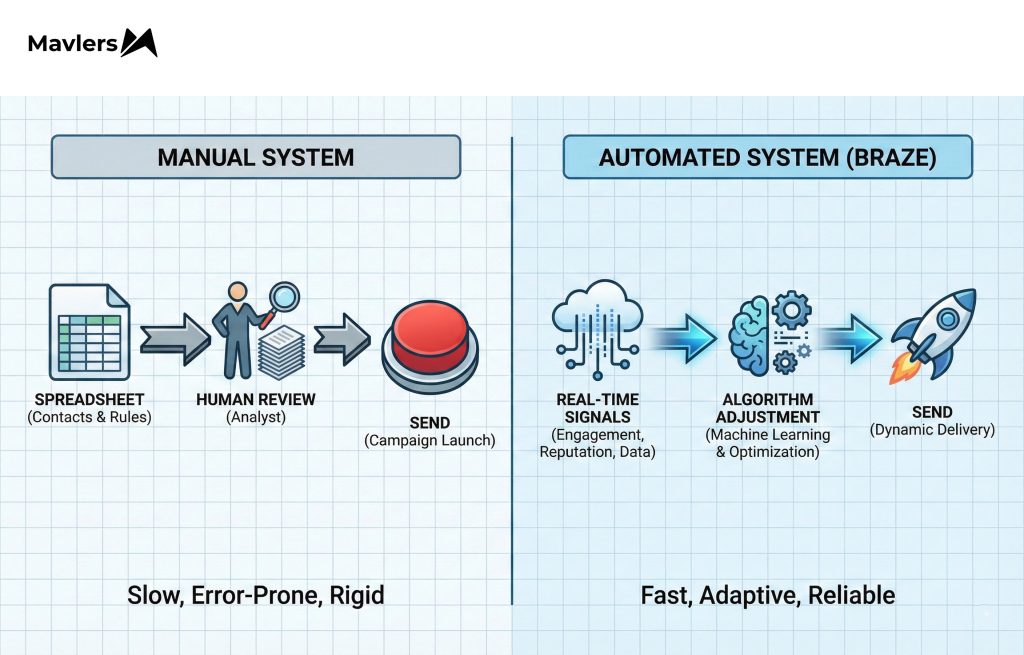
That’s where the next-gen, automated IP warming comes into the picture – Braze automated IP warming.

Everything you should know about Braze automated IP warming
This is where the technology has finally caught up to the problem. Braze’s automated IP warming feature is designed to replace assumption-driven schedules with data-driven execution.
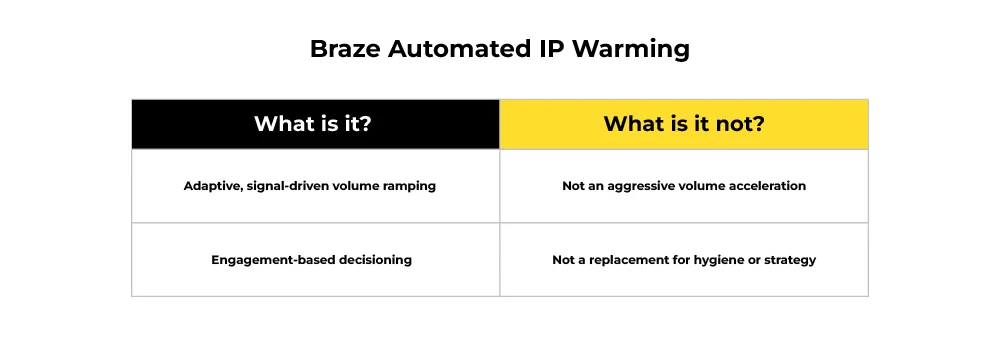
So, first things first: What is Braze automated IP warming?
- It is an adaptive, signal-driven volume ramping.
Braze automated IP warming is an intelligent system that automatically manages the daily sending limits of an IP address. Instead of following a rigid pre-set schedule, the system monitors your send performance in real-time and adjusts the volume cap for the next window based on the health of the previous sends.
- It is engagement-based decisioning.
It uses actual performance data, how your customers are reacting to your emails, to decide how fast to go.
And what Braze automated IP is not?
- It is not an aggressive volume acceleration.
It is vital to clarify that automated warming is not a “magic button” that allows you to spam. It is not a tool for aggressive volume acceleration.
- It is not a replacement for hygiene or strategy
It does not replace the need for list hygiene or content strategy. It is a governance tool, not a growth hack. It cannot make a bad email good; it can only ensure that a good email is delivered safely.
So, what role does Braze play in automated IP warming? Let’s find out.
The “set it and forget it” operational advantage of Braze
The primary benefit of this system is reduced cognitive load for your team.
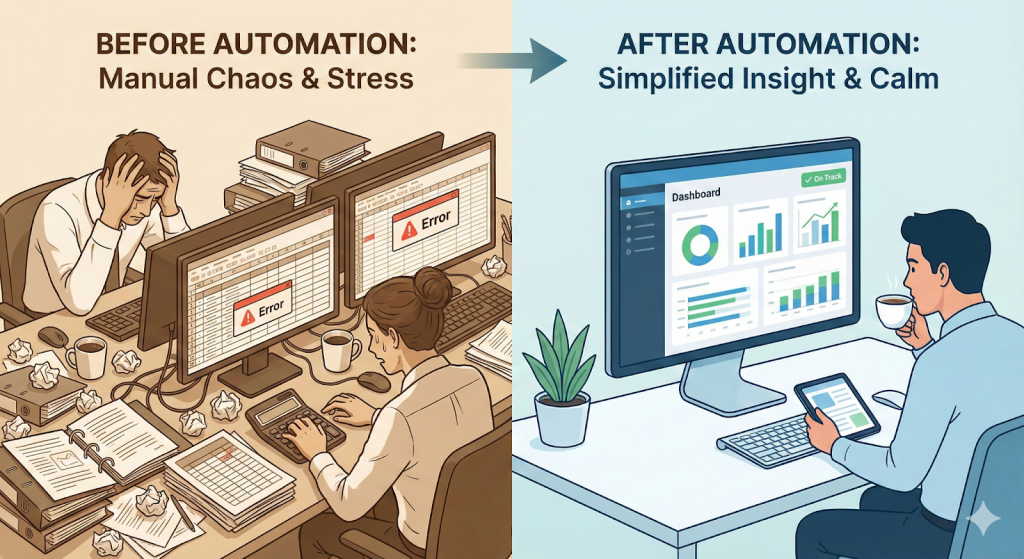
By handing the math over to the algorithm, you free your team from the daily anxiety of calculation.
That will lead to fewer spreadsheets and manual checks.
You eliminate the need to build complex segments based on arbitrary counts every day. You no longer need to manually check if you sent 4,900 or 5,100 emails.
And eventually, there will be a lower risk of human error.
If a junior marketer accidentally schedules a blast to 1 million users on Day 3 of the warm-up, the system’s Global Daily Cap will intervene. It will only send the allowable volume and queue or drop the rest (depending on configuration), preventing a catastrophic reputation suicide.
Lastly, you will achieve a faster, safer time-to-stability.
Because the system reads live signals, it will scale up as quickly as the ISP allows. If your data is clean and engagement is high, automated warming can often reach full volume faster than a conservative manual spreadsheet would allow.
Why automated warming improves deliverability outcomes
Beyond the operational ease, automation simply produces better results for the machine on the other end (the ISP).
1. Consistency over aggression
ISPs reward consistency. They prefer to see smooth, mathematical curves in volume growth. Humans are bad at smooth curves; algorithms are excellent at them.
2. Engagement-first ramp philosophy
By linking volume to engagement, you are proving to the ISP that you are listening to your users. You are aligning your sending behavior with user interest.
3. Early issue detection and mitigation
If you hit a pocket of bad data, the automated system detects the negative signals immediately. Instead of plowing ahead with the next day’s volume increase, the automation hits the brakes. This “automated throttling” mitigates damage before it becomes permanent.
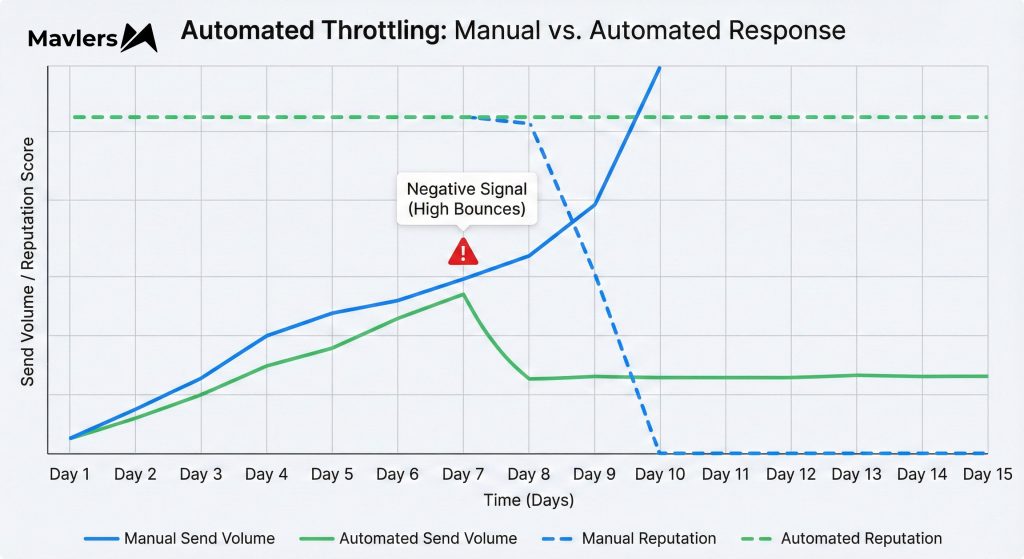
5 Common IP warming scenarios where automation excels
While automation is useful everywhere, it shines in specific high-complexity scenarios.
Here are a few common IP warming instances where automation leads the way.
1. New platform or ESP migrations
This is the classic use case. When moving to Braze from another provider, you are often moving massive audiences. Automation allows you to migrate these audiences in waves without constantly rebuilding segments manually.
2. Established audiences with no IP history
The audience is there, but the technical trust is not. Automation bridges that gap efficiently.
3. New brand or product launches
When launching a new brand, you don’t know what the open rates will be. A manual plan guesses; automation learns.
4. Seasonal or cyclical volume increases
Retailers often face “warm-up” scenarios every year before Black Friday. If your volume is dormant continuously and then spikes in Q4, you effectively need to re-warm your IPs annually. Automation makes this seasonal ramp-up a repeatable playbook.
5. Rehabilitating dormant or damaged IPs
If an IP has been “cooled down” due to inactivity, you cannot just resume full sending. Automated warming can be used to control the reintroduction of traffic, proving that the traffic is legitimate and safe.
But that’s not everything. That’s why you can’t rely entirely on automated IP warming. You need a hybrid way. You need manual interventions in addition to automated warming.
Let’s discuss the areas where human inputs are absolutely necessary.
What automated IP warming still requires from teams
It is crucial to be honest about the limitations. Automation manages the volume, but humans must manage the quality.
Here are three things you need to have human input, even while executing automated IP warming manually.
1. Clean data and list hygiene
Automation cannot fix bad data. If you feed the system a list of spam traps and invalid email addresses, it will throttle you down to zero. You must ensure that the audience entering the warm-up flow has been verified and cleaned.
2. Intentional audience selection
Engagement quality still matters. You still need to define the “seed list.” While the system handles the pacing, you must tell it who to prioritize based on intent. The strategy of targeting your most recently active users first remains valid and necessary.
3. Monitoring without micromanagement
“Set it and forget it” implies you don’t need to stress, not that you should ignore it. You still need to monitor the dashboard. If the system stops increasing volume, that is a smoke alarm. It means your creatives, your subject lines, or your data quality are failing.
Risks of over-automation and how to avoid them
Here are some risks of excessive automation and ways to overcome drift.
1. Blind trust without oversight
The biggest risk is assuming the tool is doing the strategy. If you turn on automation but point it at a cold, purchased list, you will fail. Governance is still required.
2. Weak content strategy during warm-up
Engagement depends on relevance. If your warm-up emails are boring, generic, or irrelevant, users won’t open them. If they don’t open, the automation won’t scale the volume. You need your best content during the warm-up phase.
3. Ignoring cross-channel engagement signals
Email does not live in a vacuum. If you are blasting users with Push and SMS simultaneously, you might drive email fatigue. Automation manages the IP, but you must manage the user experience.
How do you know it’s working? Let me show you exactly how.
Measuring success during automated IP warming
Here are three quick and effective ways to measure the success of your email deliverability during automated IP warming.
1. Core deliverability metrics
Are you hitting the Primary tab or Spam? Are you seeing “deferrals” in your bounce logs? Automation should minimize deferrals significantly compared to manual ramps.
2. Engagement performance indicators
You want to see steady or improving open rates as volume increases. A sharp drop indicates you have moved from your “engaged” core to your “cold” periphery too quickly.
3. Operational efficiency metrics
Calculate the hours your team used to spend on manual segmentation versus the time spent monitoring the automated dashboard.
Look at the “Intervention Rate”, how often did a human have to step in to fix a segmentation error? Ideally, this drops to near zero.
But is email deliverability enough? Or does this automated IP warming in Braze help you with other areas as well? Let’s find out.
Strategic impact of Braze Automated IP warming beyond deliverability
Here are three strategic impacts of Braze automated IP warming besides email deliverability.
1. More confident launches
When you remove the fear of “breaking” the IP, teams launch with more confidence.
2. Improved cross-team alignment
Marketing and Deliverability teams stop fighting. The tool becomes the neutral arbiter of volume. “We can’t send more because the algorithm says the engagement was too low yesterday” is a much easier conversation than “We can’t send more because I feel like it’s risky.”
3. Scalable growth with lower risk
It turns deliverability from a bottleneck into a scalable process. You can put your resources to good use without wasting an ounce of them on irrelevant processes.
Now, let’s discuss when you should use IP warming the most in Braze.
When Braze automated IP warming makes the most sense
Here are the instances where Braze automated IP warming has the most significant impact.
1. High-complexity sending environments
If you have multiple sub-brands, multiple IPs, and complex segmentation, manual warming is unsustainable.
2. Lifecycle-heavy programs
If your program relies on always-on triggered messages rather than batch-and-blast newsletters, automation is superior because it handles the fluctuating daily volumes of triggered sends naturally.
3. Rapidly scaling organizations
You need growth beyond the limits of manual processes. When you need to scale fast, you need tools that scale with you.
4. Deliverability teams seeking predictability
It allows Deliverability experts to focus on strategy (DMARC, BIMI, content optimization) rather than being spreadsheet jockeys.
Now, let’s see how agencies can fill the shoes of your in-house teams.
The role of agencies in automated IP warming
If the tool does the work, do you still need an agency or consultant? Absolutely, right question.
Here is what Braze marketing agencies bring to the table.
1. Designing the right warm-up strategy
You need audience sequencing and content planning. The tool handles the pace, but the agency handles the plan. Agencies are critical for designing the audience sequencing (who gets emailed first) and the content strategy (what do we send them to ensure they open).
2. Interpreting early signals
You need to turn data into confidence. Agencies can interpret the data generated by the automation. If the system throttles volume, an agency can diagnose why, is it a specific ISP? A specific creative?
3. Deliverability governance beyond warm-up
You need long-term reputation protection. Agencies ensure that the hygiene practices established during warm-up are maintained long-term.
Wrapping up
That brings us to the business end of this article, where it’s fair to say that IP warming should not feel like walking on glass.
For too long, IP warming has been defined by fear. It has been a process of hoping not to make a noise that wakes the sleeping giants at Google or Microsoft.
Braze automated IP warming reframes this entire experience. It turns a terrifying, manual process into a controlled, intelligent operation.
Automation replaces fear with feedback. It replaces spreadsheets with structure.
By embracing automation, we don’t just save time. We build a more resilient, respectful email program that scales with the business’s needs rather than being held back by operational limitations.
It is the simpler, smarter path to the inbox.
Connect with our Braze experts today.
That ball is your yard now. It’s time to put things into perspective.