


Every year, “Guide to Upcoming Trends” is our chance to take a clear-eyed look at what’s coming. But this year, the pace feels a tad higher. Somewhat relentless.
You see, the conversation around Paid advertising has shifted dramatically in such a short amount of time.
For instance, a year ago, many advertisers were still treating AI as a pilot project. A useful, optimistic experiment, but not yet central to how paid campaigns were run. Today, you will find AI baked in almost every aspect of the paid ad platforms that we use.
So we asked our in-house paid search expert, Chaitanya — who also consulted our entire paid advertising team — to share an honest perspective on the biggest paid advertising trends that will dominate the world of paid ads in 2026.
Take them as opportunities to power your ad strategies and rise above the noise.
Trend #1: AI is no longer the new intern—but still needs supervision
If 2024 was the year advertisers “tested” the impact of AI on paid ads, 2025–26 is when it officially moved in and claimed a desk.
Most PPC teams now rely on AI for the unglamorous-but-critical tasks: keyword expansion, copy variants, asset resizing, surfacing early performance patterns, etc. It’s meshed into daily paid ad workflows. Nobody is asking, “Should we use AI?” anymore.
But here’s the part we don’t talk about enough:
- AI has speed and scale, but it still needs watching. The outputs are quicker, sure—but the accuracy still lags.
- Anyone working in paid media has seen an AI-generated headline that reads beautifully but ignores legal requirements, exaggerates product benefits, or completely misses the industry nuance.
- In regulated categories, you still end up rewriting half of what the tool spits out just to get it past compliance.
This is the tension every advertiser is expected to learn to navigate even in 2026 : AI accelerates the doing, but not the decision-making.
Smart Bidding is the perfect example.
At Mavlers we’ve configured it well to the point that it outperforms manual bidding nine times out of ten.
But we’ve still got to keep an eye on the data feeding the model. If that’s off—achieving good results becomes challenging. Again, it’s not AI’s fault. It only knows what data you feed in.
And that’s why the teams getting the best results aren’t the ones automating everything—they’re the ones supervising intelligently. They’re feeding the models better context, cleaning inputs, reviewing outputs, and nudging the strategy when the AI veers off-track.
AI will launch campaigns faster. It will help you test creatives at a pace that was impossible two years ago. It will adapt your assets to every placement from Gmail to Shorts without breaking a sweat.
But it still won’t tell you why certain messaging resonates or how to pivot when results don’t match projections.
That part—the judgment, the pattern recognition, the feel for market shifts—that’s still firmly human territory.
In 2026, the winning Paid ad workflow looks less like “set and rest” and more like “automate the repetitive, oversee the meaningful.”
Trend #2. First-party data + privacy-first ads: the new oil rush in 2026
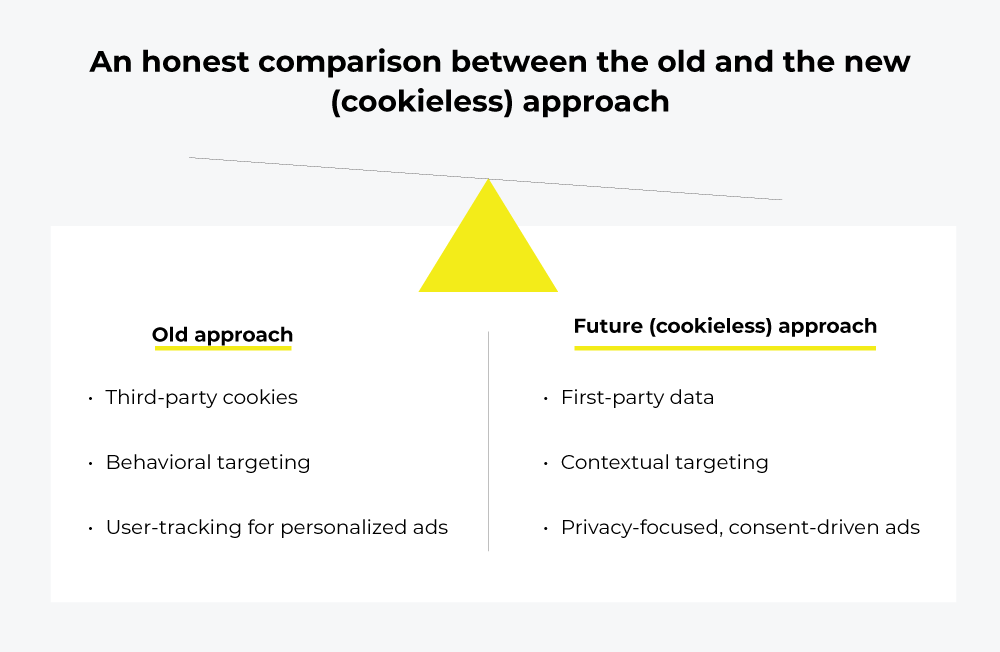
Google may have delayed third-party cookie deprecation yet again, but nobody in paid media is pretending they’ll be around forever. Privacy laws are tightening, platforms are reducing cross-site tracking, and attribution is becoming more dependent on what brands collect directly—not what’s stitched together behind the scenes.
And that’s why in 2026, first-party data is foundational for paid advertising.
This is the “consented” data customers hand over by choice. Through email addresses, purchase behavior, loyalty signals, on-site actions, and zero-party inputs from quizzes or forms. And it’s the only data the ad platforms can reliably optimize around.
The urgency becomes unmistakable in the words of Colton, Lead Consultant at WebFX, who says:
“If you’re not collecting personally identifiable information (with user consent) and sharing that with your ad platforms… you will not survive.”
Plus, with first-party data, advertisers have the best possible training material for bidding, AI-powered ad targeting, and creative algorithms. Your algorithms get smarter, cheaper, and more effective when they’re fed high-quality customer data rather than proxy metrics.
Meanwhile, contextual targeting is making a comeback—but smarter, AI-tuned, and more precise than its early 2010s version. Pairing contextual signals with first-party segments is quickly becoming the new gold standard for privacy-safe performance.
Here’s how advertisers will adapt:
- First-party data: Expect to see brands doubling down on loyalty programs, email signups, and other direct-to-consumer data collection methods.
- Contextual targeting 2.0: Ads will be placed on websites based on content relevance, with AI fine-tuning the context for better precision.
- Privacy-first platforms: Platforms will develop tools that give users more control over their data while still enabling effective ad targeting.
Tools built for the privacy-first ads (like CallRail) are also helping marketers rebuild durable attribution using first- and zero-party signals. That way, the performance remains untouched even if a browser or platform updates its rules.
Where most advertisers get stuck — and where Mavlers steps in—most brands technically “collect” data. Very few activate it well.
That’s the gap Mavlers helps close—connecting your owned data to your ad platforms, cleaning signals, building stronger segments, and designing PPC structures that still perform even as privacy walls go up.
Trend #3: Zero-click search is shrinking the click pool—And raising the stakes for paid ads
Zero-click search isn’t just an SEO problem anymore. It’s a PPC advertising problem—because when Google (or any search platform) answers the question directly on the SERP, fewer people bother clicking anything at all, including your ads. Users get what they need without leaving the page.
For advertisers, this means the pool of available clicks is getting smaller.
With fewer clicks available —
- Each high-intent click carries more weight in the auction.
- Ads see lower click-through rates simply because the audience is smaller, which directly suppresses Quality Scores.
- Lower Quality Scores, in turn, increase cost-per-click even when ad relevance and position remain unchanged.
But here’s the advertiser’s must not gloss over in 2026:
Zero-click doesn’t kill all clicks. It kills low-intent clicks. Whereas, the high-intent transactional searches or those signaling clear purchase interest like “buy car insurance online” —still drive clicks.
Understanding this distinction helps marketers focus ad budget where it delivers. Doing this will require them to move away from:
- Broad, informational keywords.
- Soft-intent queries.
- “Blue link era” CPC strategies.
- Top-of-funnel visibility plays in Search.
…and instead double down on:
- Product-level, bottom-of-funnel phrases.
- SKU or brand specificity.
- Qualifiers like “buy,” “order,” “near me,” “book today”
- Tightly themed ad groups.
- Exact SERP message-match between query → ad → landing page.
What smart advertisers will do to adapt to the zero-click searches is going to a defining digital ad trend in 2026:
1. Build micro-relevance into every ad group
Zero-click users only scroll if they’re ready to validate or buy. Your paid ad must be a perfect match for the exact search term —and the exact thing the AI Overview just recommended.
2. Maximize ad real estate
You need to occupy visual territory. More extensions. More sitelinks. More structured snippets.
3. Bid for value, not volume
You shouldn’t pay the same amount for a commodity click and a high-intent transactional click. Smart Bidding with cleaner first-party signals becomes essential here.
4. Blend PPC + SEO authority
The brand that appears in the AI Overview organically is the same brand the user is more likely to trust when they see the paid ad right below it. Authority across the full SERP matters more now than ever.
At Mavlers, this is already part of the PPC playbook. We’re adjusting structures, tightening query mapping, and building campaigns designed for the new-age SERP.
Bleeding your PPC budget? Here’s some insights to help you:
PPC Audit 101: How to Spot and Fix PPC Budget Leakages Before They Drain You
Trend #4: Speak up! Voice search ads, video and audio marketing are gonna be the next big thing!
With voice-activated devices like Amazon’s Alexa and Google Assistant becoming a staple in homes, it’s only a matter of time before voice ads take over.
In 2026, where you’ll see voice ads:
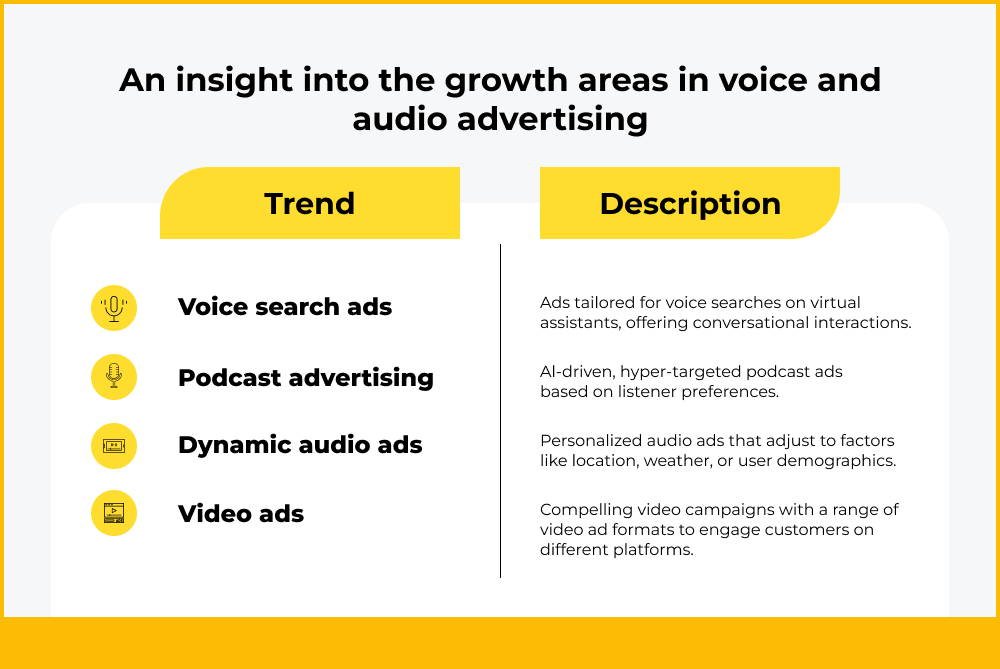
- Voice search ads: When people ask their smart speakers for recommendations, your ad could be the one answering!
- Podcasts: Personalized ads tailored to what listeners enjoy and care about.
- Dynamic audio ads: Interactive audio ads that respond to your environment—like offering a coupon for a raincoat when the weather app says it’s pouring.
- Paid video ads: Having running your video ads on platforms like YouTube, TikTok, Facebook, LinkedIn, Twitter gets you in front of broader demographics.
For a more detailed look at this latest trend, read our blogs on –
Why Video Ads Are Dominating Paid Media (And How to Leverage Them)
Optimizing ads for voice search: Unveiling the future of PPC in a voice-driven world
Trend #5. Immersive ads in Augmented and Virtual Reality (AR/VR) for the win!
By 2026, the line between real and virtual will blur even more as augmented reality (AR) and virtual reality (VR) ads become the norm. These ads won’t just be about watching or scrolling; they’ll be immersive, interactive, and downright fun.
What’s next for AR/VR ads:
- Try before you buy: Virtual try-ons for everything from clothes to furniture will be a standard feature in ads.
- Virtual events and showrooms: Brands will invite you to virtual spaces where you can explore products as if you’re in a real store.
- Gamified ads: Ads that feel like a game, where you can interact with a product, earn rewards, or unlock special discounts.
Trend #6: Sustainable paid strategies go from optional to essential
By 2026, paid advertising will be measured not just by clicks or conversions, but by impact and integrity. Gen Z and Millennials—already the largest buying cohorts—expect brands to demonstrate real environmental and social responsibility. Ads that ignore environmental impact or social responsibility risk being perceived as tone-deaf or outdated.
What kind of ads will work?
- Eco-friendly products: Ads highlighting a brand’s commitment to reducing its carbon footprint or using ethical materials.
- Cause-based campaigns: Brands aligning with social causes like environmental justice, racial equality, and animal rights.
- Transparency: Expect ads to go beyond slogans—brands will need to show measurable impact.
But mind you, this shift isn’t just limited to messaging. It’s also shaping the strategies with which campaigns are executed.
For example, a 15-second video ad can produce up to 85% more carbon emissions than a typical display ad, simply because of longer load times and heavier data processing. Reducing resolution, frame rates, or bit rates can cut emissions without sacrificing effectiveness.
Platforms like Google Ads and DV360 are already providing carbon footprint reporting, enabling advertisers to measure emissions tied to their campaigns and optimize for lower environmental impact. Expect a rise in campaigns that align bids, creative, and targeting with ethical and climate-conscious principles.
So, the newest trends in digital marketing in 2026 suggest that the most successful advertisers will:
- Prioritize intentional targeting, reaching audiences who genuinely connect with their product and values.
- Lead with authentic, transparent messaging, showcasing measurable impact rather than slogans.
- Think beyond immediate conversions, using paid ads to build community, trust, and long-term loyalty.
- Use value-driven segmentation to reach genuinely interested audiences, respecting privacy and reducing unnecessary ad exposure.
- Allocate ad spend on platforms that prioritize transparency, diversity, and sustainability, thereby ensuring your advertising contributes to positive ecosystems.
- Leverage tools like AdGreen to measure emissions and adopt lightweight creatives and green hosting.
- Focus on genuine storytelling backed by transparent data, showcase specific sustainability achievements rather than greenwashing.
- Design ads that are accessible, inclusive, and respecting user experience.
Trend #7: Blink, and you’ll miss it: short-form video ads are king
In 2026, if you’re not creating short-form video ads, you’re missing out. Platforms like TikTok ads, Instagram Reels, and YouTube Shorts have proven that the key to grabbing attention is keeping it short, snappy, and interactive.
What makes these ads so effective?
- Bite-sized content: 10-15 second ads that deliver the message fast and leave a lasting impact.
- User-generated content: Authenticity is key—using real people’s videos to promote products feels genuine and relatable.
- Interactive elements: Clickable ads where users can swipe up to shop, learn more, or explore a product.
Trend #8. Social commerce and shoppable ads: shop while you scroll
If 2026 had a motto, it would be “Make it shoppable.” Social media platforms like Instagram, Facebook, and Pinterest are already merging social and e-commerce, allowing users to shop directly from ads without leaving the app. And by 2026, this integration will be seamless across all major platforms.
What does this mean for ads?
- Shoppable ads: Ads that let you buy the product instantly, right within your feed.
- Live shopping: Think QVC meets Instagram Live, where viewers can click and buy products in real time during live streams.
- In-app purchases: No more clicking away to a website—users can buy, check out, and continue scrolling within the same app.
Imagine watching an Instagram Live session from your favorite brand, and with a tap, you can add their new product to your cart and check out without leaving the app. It’s a shopper’s dream!
The road ahead
Now that you are familiar with the expected paid advertising trends, you might want to read about
2025 Paid Media KPIs: What to Measure Instead of ROAS
The 2026 Google Ads reality check: 5 behaviors every advertiser must break
Behind the Curtain: How Mavlers Tracks, Reports, and Optimizes Every Paid Ad Dollar