

Fellow web dev brethren, tech leads, and CTOs, we all carry a memory of a moment that we don’t often admit publicly.
For some, it was staring at a deploy pipeline stuck at “Building… 17 minutes remaining.”
For others, it was probably explaining to marketing, repeatedly, why the landing page copy change needs a Git commit.
Our own moment of Waterloo of sorts arrived on a weekday, at 2:14 AM, when a Gatsby build cratered under the weight of 16,000 product descriptions.
On top of it, a VP asked the most straightforward question in Slack:
“So, why can’t we just click publish?”
It wasn’t snark, and no, amigos, it definitely wasn’t unreasonable.
On the contrary, it was the dawning realization that the choice of a static site generator becomes a business decision long before tech realizes it.
And that’s the thesis of this piece, where Next.js, Gatsby, and Hugo are not flavors; they are futures.
Three paths, each with a different ceiling, rhythm, failure mode, and long-term emotional cost.
Let’s trace them properly and in decent detail.
Hugo ~ The builder who does the job before your coffee goes cold!
When you first use Hugo, you will find a peaceful silence about it.
You will come across no dependency trees or npm audits screaming at you, and no philosophical demands about routing or hydration.
Hugo feels much like how the internet used to feel; fast, predictable, and almost austere.
A Senior Dev once summed it up pretty perfectly on a Quora thread, “Hugo gets out of your way. It’s like it’s embarrassing to be seen.”
Now, let’s understand why teams appreciate Hugo.
When pages are mostly static, performance matters more than animation, and feature requests aren’t being flung like ninja stars, Hugo offers peace.
Docs teams adore it, engineering blogs thrive on it, and internal handbooks live forever without supervision.
The builds, oh, the builds, are so fast you begin to question every other framework you use.
Here’s a quick nerd stat that you might enjoy, Hugo compiles thousands of pages in milliseconds because it’s written in Go and doesn’t drag a universe of JavaScript along.
But, incidentally, Hugo’s gift is also its wall.
Hugo will not authenticate users, personalize experiences, mutate content on the fly, and turn into an app with API routes next quarter.
If a Hugo site were a building, it would be much like a library, perfect, quiet, immaculately organized, but no one is living on the top floor.
The wall is honorable, visible, and predictable. When you respect it, Hugo will serve you for years.
Gatsby ~ The dreamer with a toolbelt full of niches
Gatsby burst into the world like a revolution. It’s a beautiful conflation of React, GraphQL, static generation, and far-too-clever plugins.
A generation of developers whispered, “This is the future of the web.”
And for a moment, it was.
It can pull data in from anywhere, normalize it, and compile it into a blazing static site
Be it CMS, Shopify store, API, Airtable, Notion, or Gatsby pulls it all together like a conductor tapping his baton.
Here’s where Gatsby might still make sense.
~ Content-rich marketing sites
~ Growth-stage SaaS companies
~ Publishers with distributed data
~ Teams where content velocity holds more value over dev constraints
Marketing loves Gatsby because Gatsby loves structured chaos, you know, a landing page here, a campaign page there, and refreshed copy daily.
Where Hugo says, “No, thank you,” Gatsby says, “Sure, give me another endpoint!”
Gatsby’s idea is still quite brilliant today. But there is a cost that might show up later.
We suggest that you ask anyone who kept a Gatsby site alive for 18 months, and they will tell you that build times creep, plugins conflict, and GraphQL becomes both a blessing and a gatekeeper.
Here is one Reddit comment that rings true, “Gatsby is incredible until it becomes your problem child.”
And this is not because Gatsby is bad, well, honestly, it isn’t.
It’s just optimized for a very particular battle, you know, for marketing-intensive sites with a React-shaped brain.
If your site begins to resemble an application, Gatsby’s scaffolding buckles, albeit not catastrophically.
Next.js ~ The framework that refuses to stay in a box
Well, Next.js is not a static site generator, not in spirit, though, not anymore.
Even though it can generate static pages, pre-render routes like Hugo, and can hydrate like Gatsby, however, Next.js’s true identity is simpler; it is the framework you choose when you can’t afford to pick twice.
Let’s get to why senior teams quietly prefer standardizing on Next.js.
Well, for starters, because the unknowns are pretty real!
The site might need user personalization, or protected dashboards, micro-frontends, or it might become a product with a budget
And when leadership asks, “Can we add a logged-in state?” Next.js is probably the only one that doesn’t flinch.
However, there are two sides to every coin, so let’s explore the burden that comes with power.
It’s important to note that Next.js demands a sense of architectural discipline, a willingness to tune performance yourself, patience for features that change quickly, and comfort with a toolchain that evolves monthly.
It is quite the opposite of Hugo’s monastic stillness. Next.js is the amalgamation of motion, choice, and responsibility.
But in exchange, it offers something no other contender does, which is a gentle ramp from static brochure site to enterprise SPA, without a rewrite.
Ask CTOs at scale what they fear most, and you’ll hear a whisper, “Well, honestly, I don’t want to migrate frameworks again.”
Next.js is the antidote to that very dread.
Getting to the part that nobody talks about enough ~ Understanding the organizational costs involved!
To lay out the facts, choosing between these three goes way beyond routing models, build speeds, hydration strategies, or plugin ecosystems. In the real sense, it’s more about human systems.
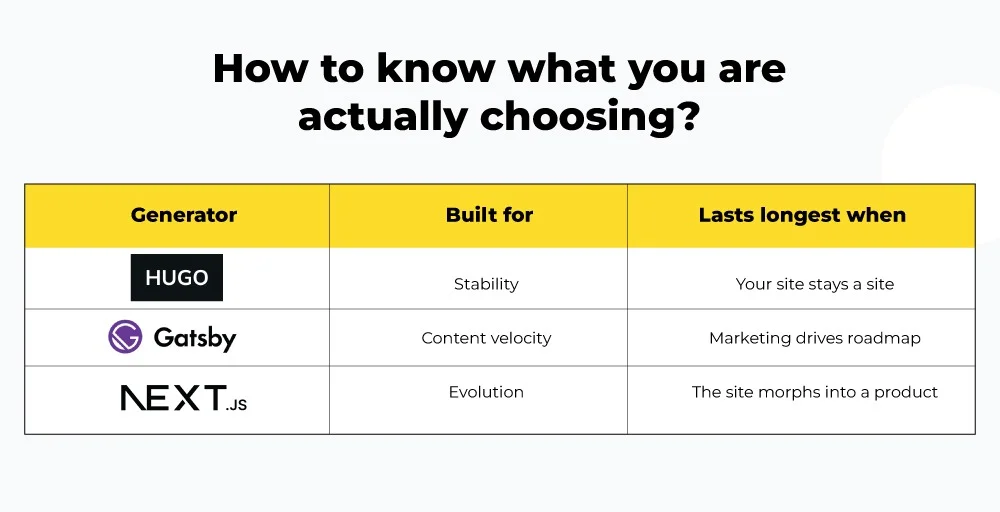
While Hugo optimizes for tiny teams, durable content, low maintenance, and predictable deployments, Gatsby focuses on frequent content updates, distributed authorship, marketing-led roadmaps, and image-heavy storytelling.
On the other hand, Next.js is great for long-term growth, handling unknown requirements, continuous iteration, and engineering-led decisions.
So it’s a smart move to side with Gatsby when marketing drives revenue, Hugo when stability drives sanity, and Next.js when flexibility drives the roadmap.
On that note, ladies & gentlemen, that’s the real “static site generator comparison” no vendor ever prints.
Unveiling the shared secret
Honestly, there is no best static site generator, only the one that is best for your team, for your runway, and for the shape of tomorrow’s problems.
And if your job title contains “Lead,” you know your real responsibility is not picking the hottest tool, instead it’s picking the tool with the right failure modes.
Hugo fails gracefully by saying no, Gatsby fails loudly at build scale, and Next.js fails silently by growing complexity.
So, pick the failure you’re prepared to manage.
Are you still on the fence? Well, this should help you get off it.
Hugo is for sites that remain sites, Gatsby is for sites that behave like content machines, and Next.js is for sites that eventually become products.
If you know which one you’re actually building, the choice stops being difficult.
If you don’t know yet, you could start with Next.js, or Hugo, and never Gatsby by accident.
Need to hear from the experts? This is what they have to say, “Tools are temporary and so are architectures, and roadmaps mutate. But the thing that endures is the cost of switching. So, choose the stack you won’t apologize for three quarters from now.”
The road ahead
On that note, if you would like to delve deeper into the offerings of Hugo as a static site generator of choice, then we recommend reading ~ Static, but Far from Stale: Should You Use the Hugo Static Site Generator?