 Lifecycle marketing
 Customer data management
 Email campaign production
 Search marketing
 CMS development
 Who we are
 How we work
 Case studies
 Testimonials
 Salesforce Marketing Cloud
 Braze
Braze HubSpot
 Marketo
 Pardot
 DataBricks
 Snowflake
 HighTouch
 RudderStack
 Segment by Twilio
 Videos
So, if you have spent enough time in SEO, you are already familiar with the truth that, technically, we don’t suffer from a lack of data; on the contrary, we bear the brunt of a dire lack of clear interpretation and prioritization.
SEMrush shows thousands of keywords, dozens of competitors, and hundreds of ranking changes.
Yet teams still tend to ask;
• Which opportunities should we tackle first?
• Which keywords will realistically move the needle?
• Why are competitors winning certain SERPs?
• What content should we build next?
This is the interpretation gap.
At Mavlers, we use ChatGPT integrated with the SEMrush connector to systemise analysis, thereby turning raw metrics into structured decisions.
Below is the exact workflow we use, with real prompts, tangible outputs, and clear decision rules you can replicate in minutes.
But first, what does “ChatGPT + SEMrush integration” actually mean?
Let’s be precise in our terminology; this is not a mysterious third-party tool.
In practice, it’s SEMrush data and a structured ChatGPT prompt workflow (and, optionally, SEMrush’s official ChatGPT app, where available).
Most teams use the SEMrush Keyword Magic Tool, organic research & gap analysis, and position tracking (optional).
We at Mavlers export or pull structured keyword data and then analyze it using ChatGPT prompts.
Here are some prerequisites for you, before you get started;
~ SEMrush Guru/Business access (best for intent + SERP features)
~ Keyword Magic Tool data (CSV or sheet)
~ Competitor Organic Research reports
~ Clear business relevance filters
An insight into how we actually use ChatGPT integration with SEMrush at Mavlers
Step 1: SEMrush input
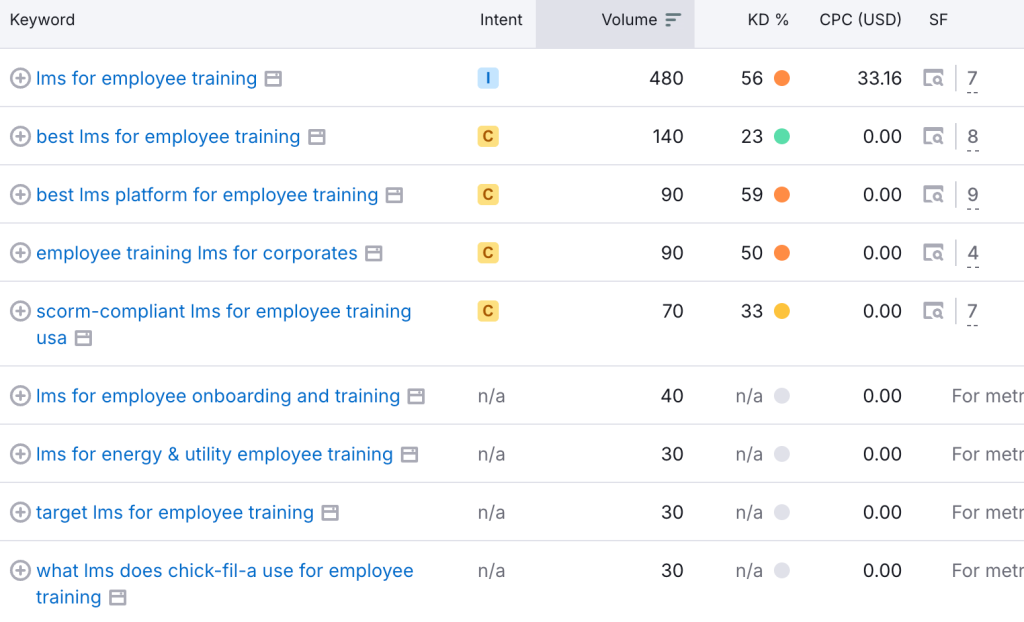
Let’s take an example niche of “Online LMS for employee training.” The primary business goals are demo requests, HR/L&D-qualified leads, and mid-funnel evaluation traffic (not students, not generic “online courses”).
From the SEMrush Keyword Magic Tool, we pull:
~ Keyword Intent
~ Keyword Volume
~ Keyword Difficulty
~ SERP Features
~ Position Tracking (if available)
Step 2: Prompt we use in ChatGPT
This is the prompt we input ~
| Using the SEMrush keyword data sheet attached above, identify keywords that are: 1) realistically rankable in 3–6 months 2) aligned with informational or commercial investigation intent 3) suitable for TOFU or MOFU content Exclude keywords with high competition or weak business relevance. Return: – Top 3 priority keywords – Recommended content type – Reason for prioritization |
Step 3: Output (what ChatGPT returns in practice)
Top Priority Keywords 1️⃣ best lms for employee training Intent: Commercial investigation (MOFU) Why this wins in 3–6 months:• Moderate competition compared to head terms• SERPs dominated by comparison guides (not brand monopolies)• Strong evaluator intent Recommended content type: Buyer’s guide/comparison post Example title: “Best LMS for Employee Training: Features, Use Cases & How to Choose” Why prioritize: • High relevance to demo-ready users • Strong internal linking potential • Proven conversion behaviour in B2B funnels 2️⃣ online lms for employee training Intent: Commercial investigation (MOFU) Why this wins: • Clear solution-seeking intent • Less saturated than generic LMS keywords • SERPs favour product/solution pages Recommended content type: Core solution landing page Example: “Online LMS for Employee Training: A Practical Guide for HR Teams” Why prioritize: • Closest semantic match to core offering • Ideal for absorbing secondary keywords • Strong buyer alignment 3️⃣ lms for employee onboarding and training Intent: TOFU → MOFU bridge Why this wins: • Lower competition • Clear use-case framing • SERPs reward structured guides Recommended content type: Use-case driven content Why prioritize: • Captures early-stage buyers • Supports longer sales cycles • Natural education funnel |
However, a note of caution, a caveat if you may, is due here;
We apply a scoring model:
| Opportunity Score =(intent fit × business value × rank feasibility × content gap severity)− (SERP volatility + cannibalization risk) |
Also, we do not treat AI outputs as final decisions. Every recommendation is validated against:
~ Manual SERP intent checks
~ Cannibalisation risk
~ Business relevance and ICP alignment
Before any recommendation goes live, we verify the following:
~ SERP intent matches the proposed content type
~ No keyword cannibalization with existing pages
~ Keyword supports a clear TOFU or MOFU journey
~ Business relevance validated with stakeholders
~ AI recommendations reviewed as hypotheses, not conclusions
This single checklist dramatically increases trust.
Step 4: Delivering SEO reporting that clients actually understand
Honestly, this might be the most underrated benefit.
Instead of overwhelming clients with raw metrics, we use this integration to:
~ Translate SEO performance into business impact
~ Explain trends in simple language
~ Highlight what changed, why it changed, and what we’re doing next
This makes SEO reporting transparent, actionable, and easy to trust.

Why Mavlers uses this approach
So, we don’t use AI to replace expertise, instead we use it to amplify strategic thinking.
By combining SEMrush’s industry-leading data, ChatGPT’s analytical and explanatory capabilities, and Mavlers’ hands-on SEO experience, we deliver strategies that are data-driven, context-aware, scalable, and aligned with modern search behaviour.
Who stands to benefit the most from this approach?
While this model is not everyone’s cup of tea, it’s incredibly effective for:
~ Brands looking to scale organic growth efficiently
~ SEO teams that want faster insights without losing accuracy
~ Enterprises seeking clear, executive-friendly reporting
~ Businesses preparing for AI-led search and discovery
The road ahead
Experts on the house reiterate the fact that “the future of SEO is not about more tools, it’s about better interpretation of data.”
In case you’d like to learn more about the future of SEO, we recommend reading ~ Unravelling the 4 layers of SEO in 2026: What SEOs really need to know.