 Lifecycle marketing
 Customer data management
 Email campaign production
 Search marketing
 CMS development
 Who we are
 How we work
 Case studies
 Testimonials
 Salesforce Marketing Cloud
 Braze
Braze HubSpot
 Marketo
 Pardot
 DataBricks
 Snowflake
 HighTouch
 RudderStack
 Segment by Twilio
 Videos

If you sell through marketplaces like Shopee or Lazada, Meta ads for marketplace sellers can drive traffic—but they don’t always carry the data back with them.
A shopper might click your Instagram ad, browse a few SKUs on your Lazada store, compare prices, even add something to their cart. And you’d still see nothing beyond the initial click inside Ads Manager.
From Meta’s perspective, the journey ends the moment someone lands on a third-party platform. That creates a visibility gap Meta ads for marketplace sellers trying to understand what their ad spend is actually doing downstream.
Collaborative Ads, also known as Collaborative Performance Advertising Solutions (CPAS), or Facebook CPAS, were introduced to address this exact disconnect by linking retailer-side browsing and purchase behavior with Meta’s campaign data. So ad performance can be evaluated based on marketplace activity, not just platform engagement.
In this Meta advertising options comparison, we’ll break down:
- What CPAS ads are and how they work.
- The core CPAS vs meta ads difference.
- When to use CPAS ads and why.
- Common mistakes advertisers make.
- Best-practice funnel strategy with CPAS advertising for e-Commerce
Let’s get to the business.
What is CPAS advertising?
CPAS (Collaborative Performance Advertising Solutions) is one of Meta’s advertising solutions. With CPAS, brands collaborate with marketplace platforms like Shopee and Lazada and run trackable, conversion-driven ads. This makes CPAS advertising for e-commerce marketplaces measurable inside Meta.
Before we get into the details of CPAS, let’s get the confusion around some common terms—Brand, Retailer, and Merchant—out of our way.
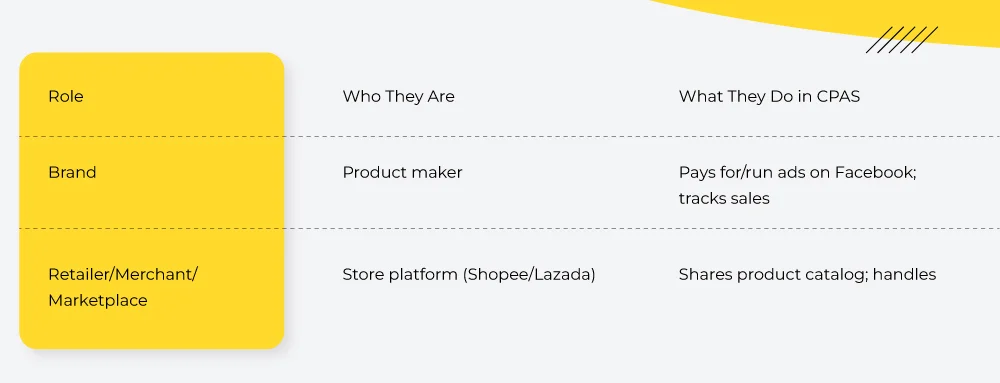
Imagine Nike makes cool sneakers. They design and produce them. But they don’t sell directly to you. They team up with Shopee, an online store like a giant mall, and list those sneakers on them. In context of CPAS,
- Brand (e.g., Nike): The company that creates the products. They fund Facebook ads, promote the products, and get sales data. In CPAS, the brand runs the ad campaign using the retailer’s product list.
- Retailer (e.g., Shopee or Lazada): The digital storefront or the hosting platform for brands to sell products to shoppers. They provide their product catalog directly with the brand’s Facebook account. Shoppers buy on their site.
- Merchant (same as Retailer or Marketplace here): Just another word for the seller/store.
In short,
Through CPAS, the retailer:
- Creates a product catalog based on your store.
- Connect it directly to your Meta Ad Account.
- One of the biggest benefits of CPAS ads: It enables marketplace actions to be tracked inside Ads Manager.
This solves one of the biggest data gaps in e-commerce advertising. Let’s find out how.
How CPAS makes marketplace sales measurable inside Meta (Unlike standard Meta ads)
When you enable CPAS, the retailer you sell through (Here, Shopee or Lazada) creates a product catalog with the help of your marketplace listings. It connects the catalog directly to your Meta ad account. That catalog is the foundation for your campaigns, as the ads you run should reflect real-time product availability instead of redirecting to a generic store link.
To illustrate this CPAS vs meta ads difference—
Say, a shopper comes to your Lazada listing by clicking on your Meta ad for a Bluetooth speaker. They complete the purchase later that night after scrutinizing the product specifications and adding it to cart.
If it was for standard Meta ads, none of these post-click actions would be visible in your Ads Manager because Meta’s tracking pixel can’t be installed on third-party marketplaces.
Fortunately, benefits of CPAS ads are in place.
CPAS addresses this disconnect by letting the retailer securely share anonymized behavioral signals back to your Meta account. This covers the entire high-intent spectrum—product discovery, carting behavior, and successful conversions.
This data flow changes what your campaign reporting can actually capture.
Instead of relying only on engagement metrics, advertisers can now evaluate downstream actions like:
- Add-to-cart events
- Add-to-cart value
- Purchase value
- Return on Ad Spend (ROAS)
When you can combine the brand’s ad visibility with retailer-side purchase intent, the next step becomes much easier for you. And that is to optimize your campaigns around in-market shoppers who are already evaluating products. CPAS makes this happen.
This has a measurable impact.
As per Meta, collaborative Ads have shown up to a 24% year-over-year improvement in ROAS across implementations.
In one retail-linked activation, Meta reports that Coca-Cola’s sugar-free portfolio saw a 39% lift in ROAS, 2.5× stronger conversion rates, and 40% lower acquisition costs when campaigns were informed by marketplace catalog signals rather than broad targeting.
In effect, CPAS connects product discovery on Meta with conversion activity happening inside Shopee or Lazada, helping bridge one of the most persistent attribution gaps in marketplace-led e-commerce advertising.
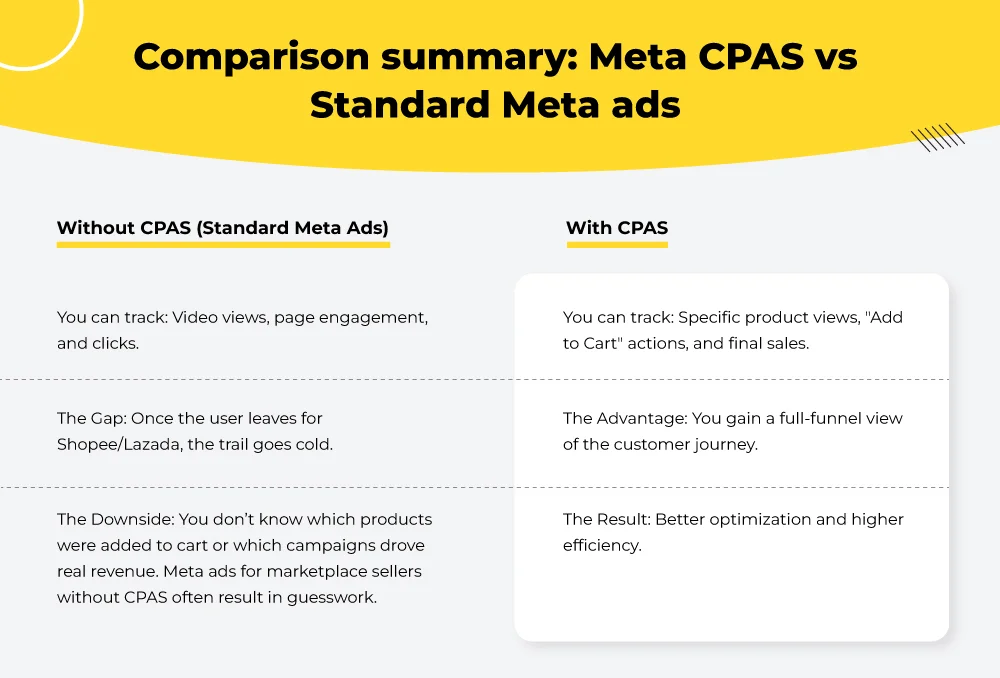
Without CPAS, You can track:
- Video views
- Page engagement
- Clicks on the ad
…but as soon as the user leaves Facebook and visits Shopee/Lazada:
- Product views are not tracked
- Add-to-cart is not tracked
- Purchases are not tracked
- Retargeting signals are lost
Which means, you don’t know:
- Which products people viewed.
- Whether they added to cart.
- What drove conversions.
- Which campaigns brought real revenue.
Consequently, Meta ad optimization becomes guesswork.
With Facebook CPAS, Shopee or Lazada can share anonymized marketplace-side actions back to your Meta account and lets you:
- Retarget users who actually showed buying intent.
- Show ads based on products they explored.
- Promote related items or bundles.
- Build lookalike audiences using real purchasers.
- Reduce wasted spend on low-intent traffic.
Comparison summary: Meta CPAS vs Standard Meta ads
Dig deeper:
- The hidden half of your paid media: Why ignoring the dark funnel could be killing your ROAS
- Behind the Curtain: How Mavlers Tracks, Reports, and Optimizes Every Paid Ad Dollar
Benefits of CPAS ads for marketplace sellers: Targeting, retargeting, and higher ROAS
One of the biggest advantages in the CPAS vs regular Meta ads comparison is how closely your campaigns can align with actual buying behavior on Shopee or Lazada. That’s way beyond just engagement inside Meta.
1. Retailer-linked product integration
With Facebook CPAS, your ads are powered by the retailer’s live product feed.
This allows campaigns to:
- Show real-time inventory from your Shopee or Lazada store
- Link directly to the relevant product page
- Reduce the number of steps between discovery and purchase
Instead of clicking an ad and landing on a general storefront, shoppers are taken straight to the product they interacted with—making the purchase journey quicker and more intentional.
2. High-intent retargeting
With standard Meta ads, retargeting often relies on:
- Ad clicks
- Video views
- Page visits
But for Meta ads for marketplace sellers, these signals don’t always indicate purchase interest.
CPAS changes that by allowing campaigns to retarget users who:
- Viewed specific products on Shopee or Lazada.
- Explored multiple variants.
- Added items to cart.
- Purchased from your store previously.
This makes CPAS especially useful for:
- Repeat purchase campaigns.
- Upselling existing customers.
- Cross-selling related items.
- Long-term customer retention.
3. Dynamic product recommendations
Another key benefit of CPAS ads is the ability to automatically serve relevant product suggestions based on marketplace behavior.
For example:
If a shopper browses a compact office desk on your Lazada store but doesn’t convert, your next ad could feature:
- Matching storage units.
- Ergonomic desk chairs.
- Cable management accessories.
This improves:
- Ad relevance
- Click-through rates
- Conversion potential
And makes remarketing less repetitive.
4. Basket growth through smart cross-promotion
Effective CPAS advertising for e-commerce marketplaces goes beyond simply reminding users what they saw.
You can structure retargeting sequences like:
- 1–2 days: Show the originally viewed product.
- 3–5 days: Promote complementary items.
- Later: Introduce premium variants or bundles.
This approach can:
- Increase average order value.
- Improve campaign ROAS.
- Support product bundling strategies.
5. Lower CAC and expanded reach
Because CPAS leverages retailer-side first-party data:
- Targeting becomes more efficient.
- Budget is focused on in-market shoppers.
- Customer acquisition costs can be reduced.
At the same time, brands gain access to the retailer’s broader customer base—unlocking new audience segments beyond their own first-party data.
In most Meta advertising options comparisons, this power to link platform discovery with marketplace purchase signals is what makes CPAS particularly effective for lower-funnel campaigns.
How to use CPAS ads across the marketing funnel
According to the Mavlers experts, one of the most common mistakes advertisers make is: Running only CPAS retargeting campaigns.
Retargeting only works if new users keep entering the funnel.
Many advertisers get excited about retargeting tactics and forget:
- You cannot keep recycling the same audience.
- Retargeting eventually saturates.
- Performance starts declining.
A healthy CPAS funnel should look like this:
1. Top-of-Funnel (New Customers)
To bring in new traffic and fresh intent
2. Middle-of-Funnel (Product Browsers)
This is to nurture research-stage shoppers
3. Bottom-of-Funnel (Add-to-Cart & Buyers)
At this stage, it is to convert and upsell
The more quality traffic you feed at the top:
→ The stronger your retargeting pool becomes.
→ The healthier your funnel stays.
→ The more sustainable your revenue growth is.
CPAS retargeting mistake to avoid: Targeting too long after intent fades
Another common mistake in CPAS advertising for e-commerce that we’ve seen many clients commit is stretching retargeting windows far beyond when purchase intent actually exists.
Some marketplace-led training programs recommend retargeting users for up to 180 days. On paper, that sounds like a way to stay top of mind. In practice, it often does the opposite—driving up frequency without improving conversions.
That’s because buying intent has a limited window.
For most Shopee or Lazada purchases:
- Low to mid-priced items tend to convert within 2–3 days.
- Higher-priced products may take up to 7 days.
After that:
- Interest drops off.
- Shoppers move on to other options.
- Ad fatigue increases.
- The budget gets spent on low-intent users.
We recommend our clients a more effective CPAS setup, instead of retargeting broad 180-day audiences, which is:
- Shorter, behavior-based retargeting windows.
- Product-specific durations based on price or category.
- A steady flow of new users entering the funnel through prospecting.
In the CPAS vs standard Meta ads context, this balance between acquisition and retargeting becomes critical. Over-relying on long-term retargeting may limit performance, despite your tracking setup being accurate.
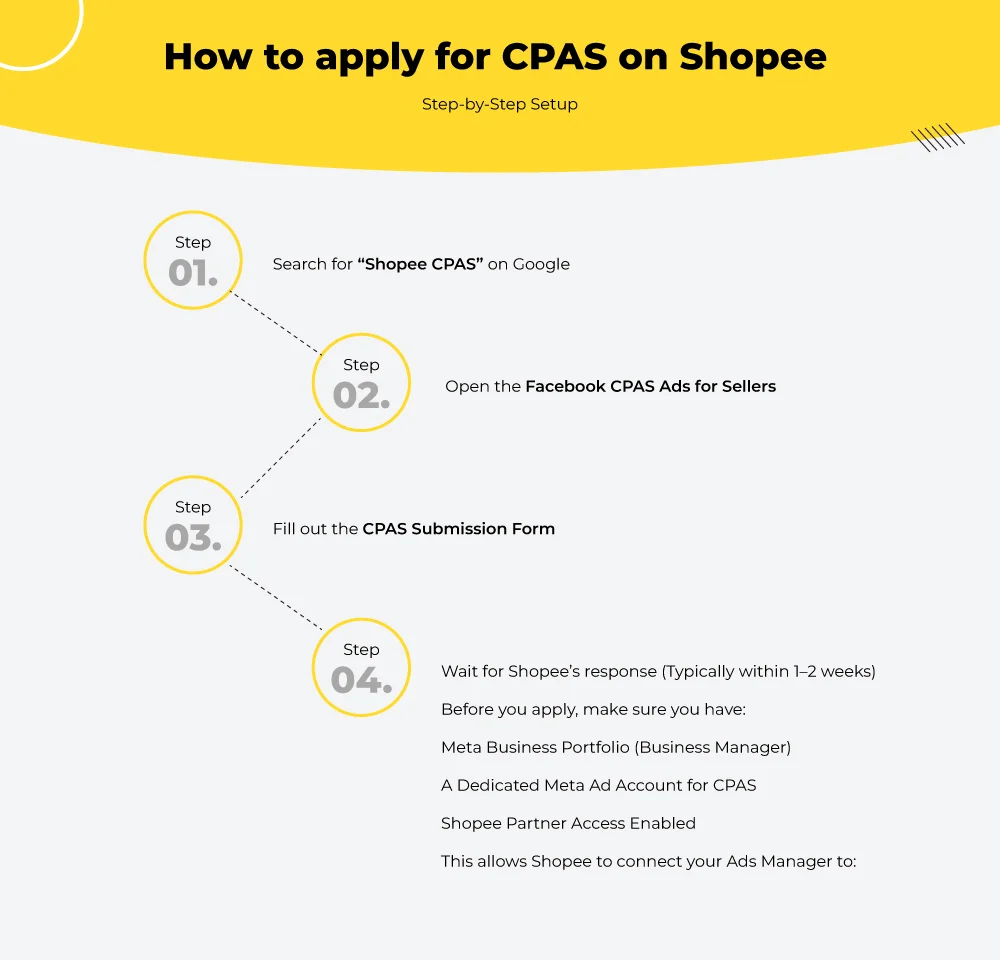
How to apply for CPAS on Shopee
CPAS vs Standard Meta Ads — Which should you choose?
Choose CPAS if you:
- Sell on Shopee or Lazada.
- Need purchase tracking visibility.
- Want retargeting based on real user behavior.
- Care about ROAS & performance optimization.
- Want to upsell or retain repeat customers.
CPAS turns marketplace selling into trackable, optimizable, and scalable performance marketing.
Choose regular Meta Ads if you:
- Drive traffic to your own website
- Run branding or awareness campaigns
- Collect leads
- Promote non-marketplace actions
Regular ads still matter — especially for:
- Demand generation
- Brand recall
- Content marketing
But…
Once your customers move to a marketplace, CPAS becomes non-negotiable.
Final takeaway
CPAS advertising transforms how brands sell on marketplaces. It allows you to:
- Track the real purchase journey
- Retarget based on actual product behavior
- Improve upsell and cross-sell opportunities
- Increase lifetime customer value
- Optimize campaigns with real revenue data
Just remember:
- Don’t rely only on retargeting
- Keep investing in new customer acquisition
- Use realistic retargeting windows
- Build a full-funnel strategy
That’s where CPAS delivers its greatest impact.
More resources from Mavlers:
- Meta Ads vs Google Ads: Where Should Your Ad Budget Go for Maximum ROI?
- The Meta Ads Hack You Need to Use: How UGC Drives More Sales